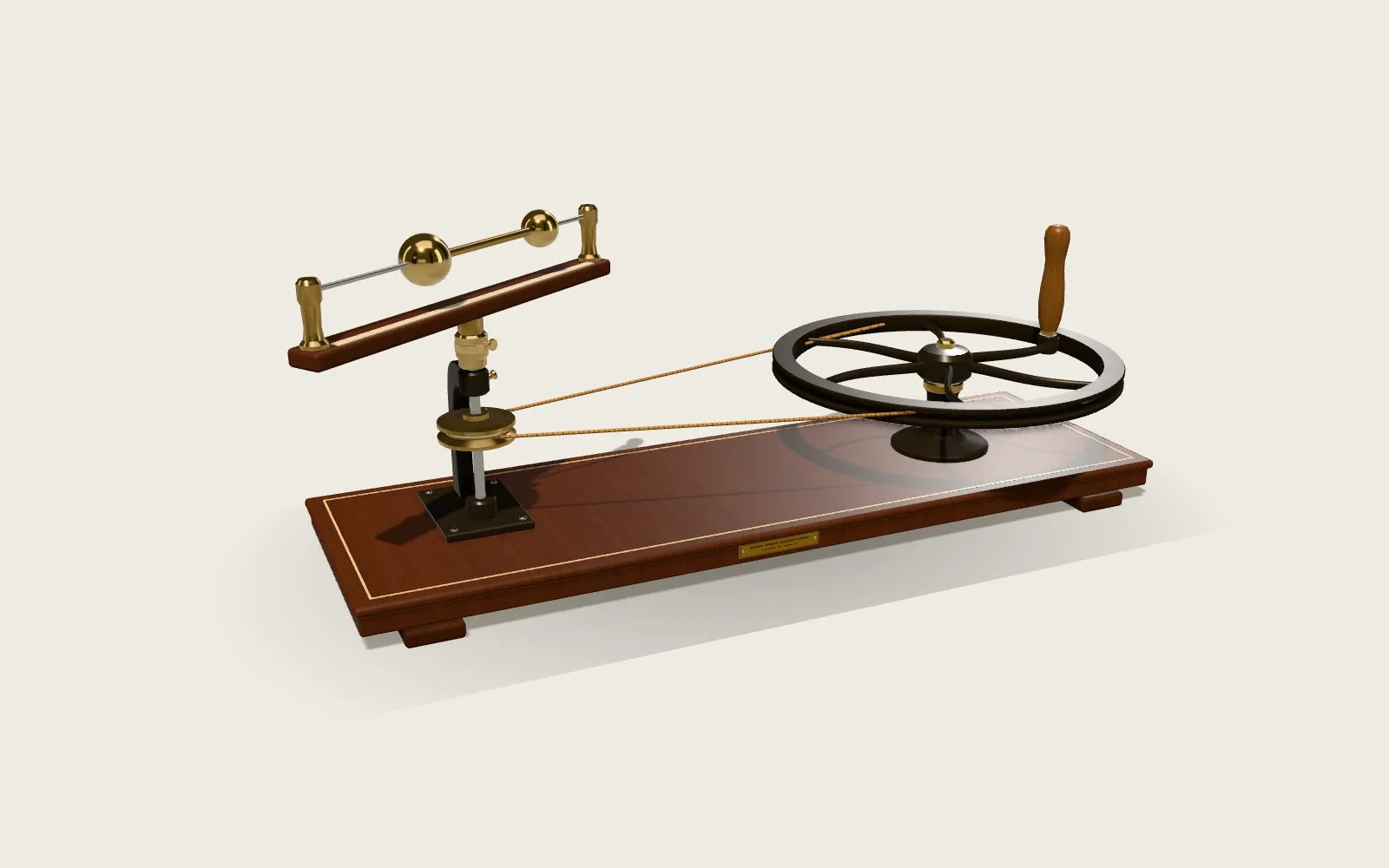
Projectile Motion
A ball leaving a table’s edge keeps its sideways speed and falls as fast as a ball simply let go. The two motions do not interfere: together they trace a parabola.
Scroll
Off the Edge of a Table
Among Galileo’s notes on motion is a page now numbered Ms. Gal. 72, folio 116v. It shows a table top, its edge and five curves falling to the floor, with numbers beside them. As the historian Stillman Drake read it, these are five throws: a ball let go at different heights on the table, leaving the edge level and landing on the floor. From the paper and its watermark he dated it to late 1608.
The unit is Galileo’s punto. Measured from the scale on his proportional compass, a punto is about 0.94 mm. The page gives the table’s height as 828 punti, about 0.78 m. Let go 300 punti up, the ball landed 800 punti out; let go 1,000 up, 1,500 out.
The page has no drawing of an incline and says nothing of the apparatus. The incline, deflector and bronze ball on the table are a model of Drake’s reconstruction; other historians read the page differently.
Released at 300, 600, 800, 828, 1,000 punti · landed at 800, 1,172, 1,328, 1,340, 1,500 punti · 1 punto about 0.94 mm
Landing Together
A catch at the edge holds a second ball, as high as the first one when it leaves the table. The moment the first ball flies off, the catch opens and the second drops straight down. This is the page’s demonstration, not an experiment Galileo made.
A flash every 1/30 s shows the two always at the same height. One is moving forward and one is not, yet they fall at the same rate. After about 0.40 s both land at once.
A flash every 1/30 s · dropped from 0.78 m · both land after about 0.40 s · the page’s model
Nothing Pushes It Forward
In 1638, opening the Fourth Day of Two New Sciences, Galileo wrote that a body moving on a level plane without friction moves uniformly and for ever; once it passes the plane’s edge it gains, besides that uniform motion, a downward tendency from its own weight.
Once the ball has left the table, the only force on it is gravity, straight down; for this bronze ball the air’s drag is too small to count. Nothing pushes it forward, and nothing slows its forward motion: from the edge to the floor it stays at 3.16 m a second.
Its downward speed starts at zero and grows by about 9.8 m a second every second. At the floor it is moving down at about 3.9 m a second.
Forward: 3.16 m/s, unchanged · down: about 9.8 m/s faster each second · the page’s model
One, Four, Nine, Sixteen
Split the 0.40 s of the fall into four equal parts, about 0.1 s each. In each part the ball goes the same distance forward, but it drops 1, 3, 5 and 7 units: 1, 4, 9 and 16 in all. Galileo proved this rule of odd numbers in the Third Day.
Two steps forward, four units down; three steps, nine units. The drop grows with the square of the distance forward: y = gx² / (2v²). That curve is a parabola.
In the first proposition of the Fourth Day, Galileo proved that a uniform motion across combined with a naturally accelerated fall traces half a parabola. The proof rests on the two motions combining “without altering, disturbing, or hindering each other.”
About 0.1 s a step · forward 1, 2, 3, 4 · down 1, 4, 9, 16
Checking the Numbers
The time to fall from the edge to the floor does not depend on how fast the ball moves forward, so how far out it lands depends only on its speed at the edge. The higher the start, the faster: four times the height gives twice the speed, and twice the distance.
That is how Galileo checked. Taking the first throw as given (300 punti up, 800 out), a start at 600 should land at 1,131; he measured 1,172. At 800, 1,306 against 1,328; at 828, 1,330 against 1,340; at 1,000, 1,460 against 1,500. He wrote the differences, 41, 22, 10 and 40, on the page.
Every measured landing is a little farther than the reckoned one, by at most 3.6 %. By today’s reckoning a ball rolling without slipping on a flat board should land farther still; the measured landings are 95 % to 98 % of that. Some historians hold that the surviving throws never showed the path’s shape clearly.
By the square root of the height: 1,131, 1,306, 1,330, 1,460 · measured: 1,172, 1,328, 1,340, 1,500 · in punti
Forty-Five Degrees
Now throw it upward at an angle, onto a board at the height it left from. Keep the speed, change only the angle, and the landing moves. Without air, 45° goes farthest: the range is R = v² sin 2θ / g.
Gunners already knew that an elevation of 45° carries farthest, and Nicolò Tartaglia wrote it in 1537. In 1638 Galileo proved it, and proved that two angles the same amount above and below 45° land in the same place: 30° and 60°, 15° and 75°. That, he said, had perhaps never been observed in practice.
Throw faster and farther still, and the curve of the ground starts to count: that is on the page The Space Station Is Falling.
3.96 m/s · 45°: 1.60 m · 30° and 60°: 1.39 m · 15° and 75°: 0.80 m · no air
With Air
The bronze ball is heavy and the air hardly holds it back: thrown at 3.96 m a second and 45°, it lands just 4 mm short of the airless mark. A table-tennis ball, far lighter, thrown the same way, lands at 1.42 m, 0.18 m short.
Drag always points against the motion, and grows with speed. The ball’s forward speed keeps falling, so the way down is shorter and steeper than the way up: the table-tennis ball leaves at 45° upward and lands at 48° downward. Galileo wrote that very fast shots make the start of the path flatter than its end.
The faster the throw, the more the air counts. A baseball hit at 44.7 m a second (100 mph) without spin would carry 204 m with no air; with air, at 45° it goes 110 m, and the angle that carries farthest drops to about 40°. Real batted balls spin backward, and in games the longest fly balls leave at about 25° to 30°.
Bronze 1.60 m · table tennis 1.42 m · baseball (44.7 m/s, no spin): 204 m in a vacuum, at best 111 m in air, at about 40°
The Apparatus, Taken Apart
The apparatus comes apart in seven pieces: the incline, the stand, the deflector, the bronze ball, the catch, the plumb line and the rule.
Rest the pointer on one and it is lifted out and named; left alone, all seven are named beside it.
Incline · stand · deflector · bronze ball · catch · plumb line · rule
Speed, Angle and Air
This is the page’s model: the ball leaves the launcher’s mouth and lands on a board at the same height. Without air the path is a parabola; with air it is worked out step by step against a drag that grows with the square of the speed. The dashed line is always the airless parabola.
The bronze ball is 25 mm across and weighs 72 g, with a sphere’s drag coefficient of 0.45; the table-tennis ball is 40 mm and 2.7 g, with its measured 0.36.
The page’s model · dashed: no air
Try thisIn the lab, take the bronze ball at 3 m/s: where does 45° land? And 30° and 60°? Now take the table-tennis ball with air on: how much shorter is 45°, and which angle goes farthest?
What the model leaves out
Galileo did not describe his apparatus: the incline’s length and slope, the deflector and the table are a model of Drake’s reconstruction, and the groove, the parchment and the bronze ball come from another incline experiment, described in the Third Day of Two New Sciences. The model’s ball rolls down the incline at the speed its landing implies, so it lands on the chalk marks; a real ball rolling in a groove, with friction, leaves the edge slower than one that slides without friction. Historians differ on the punto’s length: Drake himself took 29/30 mm; the page uses the usual 0.94 mm. The catch for the second ball and the landing-together demonstration are this page’s design. The bounce after landing is only a sketch. Drag is worked out with a fixed drag coefficient, with no spin and no wind; the baseball’s figures leave out spin too. On the board the ball starts and lands at the same height, which is where “45° goes farthest” holds; launched from above the landing point, the angle that carries farthest is below 45°. The flashes, the slow motion and the bounce are there to make things visible.
Easy to get wrong
Once the ball leaves the table, nothing pushes it forward, and its forward speed does not “run out”; only air slows it. A thrown ball does not fly straight and then drop: it is falling from the moment it leaves. That older picture was drawn before Galileo; in Tartaglia’s book the path is a straight line, then an arc of a circle, then a vertical drop. Without air a heavy ball and a light one fall at the same rate; in air a light, large ball is held back far more. “45° goes farthest” holds only without air and with launch and landing at the same height. The parabola itself is the shape near the ground and without air.
Common questions · 5
- Does a ball thrown sideways land later than one dropped at the same moment?
A flash every 1/30 s shows the two always at the same height.
02Landing Together ↑- Why does a thrown ball keep moving forward?
Nothing pushes it forward, and nothing slows its forward motion: from the edge to the floor it stays at 3.16 m a second.
03Nothing Pushes It Forward ↑- How far does a ball thrown sideways fall in equal times?
In each part the ball goes the same distance forward, but it drops 1, 3, 5 and 7 units: 1, 4, 9 and 16 in all.
04One, Four, Nine, Sixteen ↑- Which angle throws farthest?
Without air, 45° goes farthest: the range is R = v² sin 2θ / g.
06Forty-Five Degrees ↑- How does air change a projectile’s path?
The ball’s forward speed keeps falling, so the way down is shorter and steeper than the way up: the table-tennis ball leaves at 45° upward and lands at 48° downward.
07With Air ↑
Sources
- G. Galilei (1638): Discorsi e dimostrazioni matematiche intorno a due nuove scienze (Two New Sciences), transl. H. Crew and A. de Salvio (1914), Third and Fourth Days
- Biblioteca Nazionale Centrale di Firenze, Istituto e Museo di Storia della Scienza and Max Planck Institute for the History of Science: Galileo’s notes on motion, Ms. Gal. 72, electronic edition, folio 116v (description and calculations)
- The same: folio 116v in facsimile (Max Planck Institute for the History of Science)
- S. Drake (1973): Galileo’s Experimental Confirmation of Horizontal Inertia: Unpublished Manuscripts, Isis 64
- S. Drake and J. MacLachlan (1975): Galileo’s Discovery of the Parabolic Trajectory, Scientific American 232
- S. Drake (1985): Galileo’s accuracy in measuring horizontal projections, Annali dell’Istituto e Museo di storia della scienza di Firenze 10 (abstract)
- R. H. Naylor (1974): Galileo and the Problem of Free Fall, British Journal for the History of Science 7 (abstract)
- J. Renn, P. Damerow and S. Rieger (2001): Hunting the White Elephant: When and How did Galileo Discover the Law of Fall?, Science in Context 14
- F. S. Crawford (1996): Rolling and slipping down Galileo’s inclined plane: Rhythms of the spheres, American Journal of Physics 64 (abstract)
- R. Vergara Caffarelli: How long is Galileo’s punctus?
- M. Valleriani (2013): Metallurgy, Ballistics and Epistemic Instruments: The Nova scientia of Nicolò Tartaglia, chapter 2
- OpenStax: University Physics, vol. 1, 4.3 Projectile Motion
- OpenStax: University Physics, vol. 1, 6.4 Drag Force and Terminal Speed (a sphere’s drag coefficient, 0.45)
- NIST: standard acceleration of gravity (a defined value)
- Engineering ToolBox: U.S. Standard Atmosphere (1976), air density at sea level
- NASA Glenn Research Center: Drag of a Sphere
- C. Cohen et al. (2014): The aerodynamic wall, Proceedings of the Royal Society A 470 (the table-tennis ball’s drag coefficient)
- ITTF: Statutes 2026, 2.3 (the ball’s diameter and mass)
- A. M. Nathan (2008): The effect of spin on the flight of a baseball, American Journal of Physics 76
- J. R. Kensrud and L. V. Smith (2010): In situ drag measurements of sports balls, Procedia Engineering 2 (a baseball’s drag coefficient)
- A. M. Nathan (2016): Using Statcast Data To Study The Flight of a Baseball (the launch angles that carry farthest)
Data
Folio 116v: Galileo Galilei’s notes on motion, Biblioteca Nazionale Centrale di Firenze, Ms. Gal. 72, f. 116v (the electronic edition of the Biblioteca Nazionale Centrale, the Istituto e Museo di Storia della Scienza and the Max Planck Institute for the History of Science, 1999), read as S. Drake did (Isis, 1973; with J. MacLachlan, Scientific American, 1975; Annali dell’Istituto e Museo di storia della scienza, 1985), with the doubts of R. H. Naylor (1974) and of J. Renn, P. Damerow and S. Rieger (2001). The punto after T. Settle’s measurement of Galileo’s compass, as given by R. Vergara Caffarelli. Two New Sciences (Leiden, 1638) in the English of H. Crew and A. de Salvio (1914); Tartaglia after M. Valleriani’s edition of the Nova scientia (2013). Standard gravity as defined by the CGPM (1901); air at sea level from the U.S. Standard Atmosphere (1976); a sphere’s drag coefficient from OpenStax University Physics; the table-tennis ball’s from C. Cohen and colleagues (2014); the baseball’s size from A. M. Nathan (2008) and its drag from J. R. Kensrud and L. V. Smith (2010); the fly-ball angles from A. M. Nathan (2016). Every path on the page is computed from these (computed.py and sim.js), not traced from photographs or from the folio. The table, the incline, the deflector, the catch and the launcher are this page’s model of a reconstruction, not copies of any instrument; the sheet on the table is our own drawing. Material presets and the model kit as on the site’s other model plates (public/looks/CREDITS.md).
The text, pictures and models on this page are licensed CC BY-NC 4.0: free to use and adapt for teaching and other non-commercial purposes, with credit to world.lapla.si. Third-party material listed above keeps its own licence.
Cite this plate
Laplace’s Mini World, Plate 79, “Projectile Motion”, https://world.lapla.si/en/projectile/, CC BY-NC 4.0, updated 2026-11-02.
Follow the question
 Plate 18The Space Station Is FallingAstronauts float not because there is no gravity in space, but because they and their station are always falling.
 Plate 42Light in a Glass ThreadShine a light into a stream of water and the light bends with the stream. Today the same trick traps the internet in glass threads as fine as a hair and sends it across the Pacific.