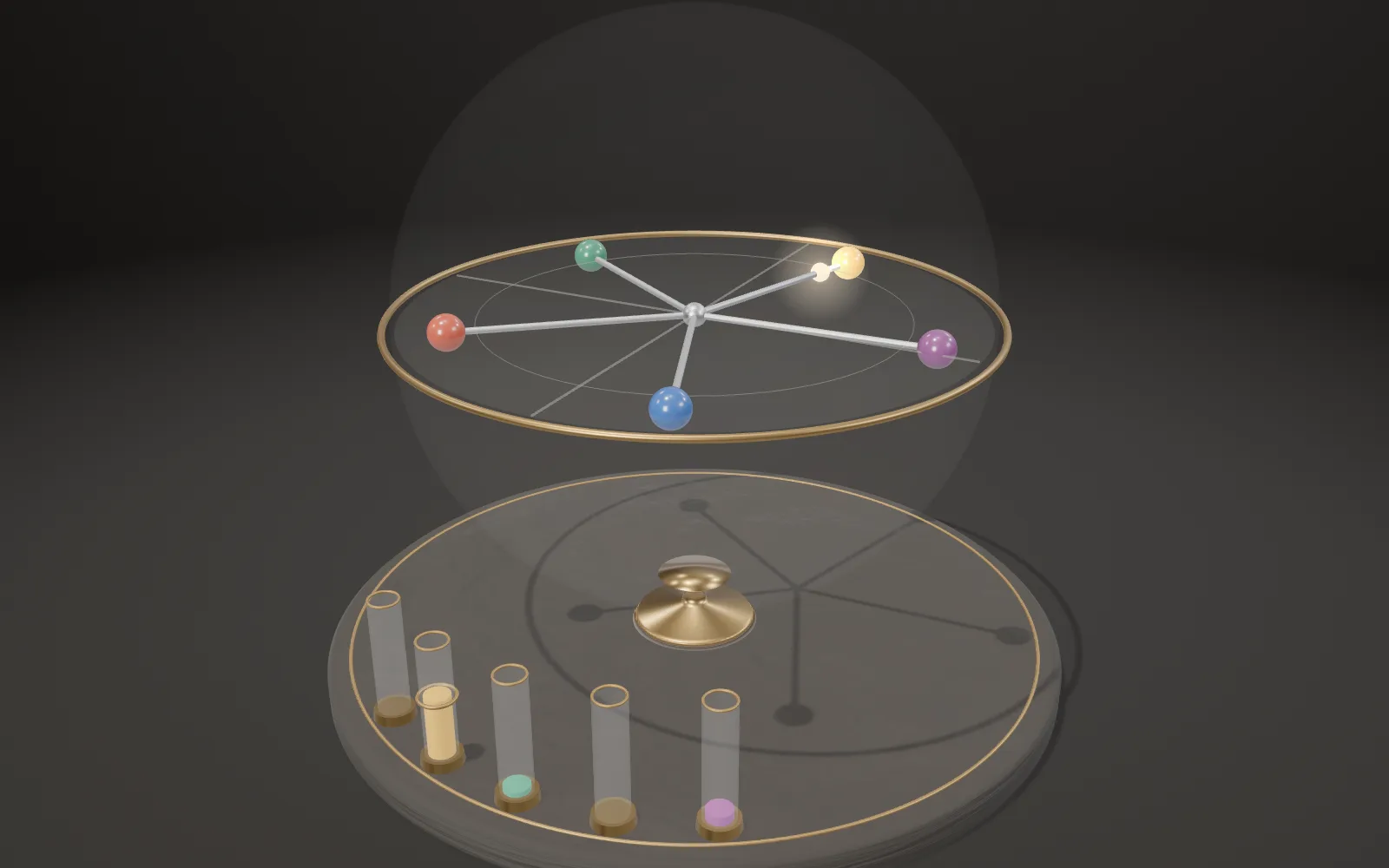
The KV Cache and PagedAttention
Every earlier token’s keys and values are kept, and they pile up as the text grows. Stored in equal blocks, like pages of memory, the cache takes room only as it fills.
Scroll
What It Does
A language model writes one token at a time. For each new token, attention needs the keys and values of every token before it; kept rather than recomputed, they are the KV cache. A server writing many texts at once keeps a cache for each, all in the GPU’s memory.
The 2023 vLLM paper measured that in the serving systems before it, only 20.4 % to 38.2 % of the memory set aside for the KV cache held tokens’ keys and values. Its PagedAttention raised that to 96.3 %, and at the same latency gave 2 to 4 times the throughput of FasterTransformer and Orca.
In the middle of the stand, the memory set aside for the cache, as a machine with 44 pockets: a pocket is a block of 4 tokens; a token is a pair of pins, the round head its key, the square head its value, coloured by the text it belongs to. Behind it, the block table; in front, the text written so far.
Earlier systems: 20.4–38.2 % holds tokens · PagedAttention: 96.3 % · 2–4 times the throughput at the same latency
One Token at a Time
The paper splits generation in two. First the prompt phase: the whole prompt in one go, which also gives every prompt token’s key and value. Then the generation phase: one token per iteration, whose own key and value are computed and attend, with all the earlier ones, to give the next token. (What keys and values are: the plate Attention in Transformers.)
Earlier tokens’ keys and values do not change in later iterations, so they are computed once and kept; each iteration computes only the new one. The generation phase, the paper notes, works on one token at a time, leaves the GPU’s arithmetic underused, is bound by memory, and takes most of a request’s latency.
On the stand, in every iteration each text being written first lights its pins, reading its whole cache, then drops one new pair; the type gains a sort. A text that has just arrived drops its whole prompt at once.
Prompt phase: the whole prompt at once · generation phase: one token per iteration · only the new token’s key and value are computed
800 KB a Token
Each token has a key and a value in every layer. The paper’s example is OPT-13B: 40 layers, keys and values of 5,120 numbers each, 2 bytes a number in 16-bit floating point. One token takes 2 × 5,120 × 40 × 2 = 819,200 bytes, which the paper writes as 800 KB. OPT texts run to 2,048 tokens, so one text’s cache can reach 1.6 GB.
The paper’s Figure 1: a 13B model on a 40 GB NVIDIA A100 spends 26 GB, about 65 %, on its weights and about 30 % on the cache; its Table 1 gives 12 GB, room for about 15,700 tokens’ keys and values. At 2,048 tokens a text, that is 7 texts.
On the stand a corner is cut away: under the cover lie 40 thin plates, one for each layer of the model. A pair of pins runs from the top right through to the bottom: a token’s key and value, kept in every layer.
OPT-13B: 2 × 5,120 × 40 × 2 bytes ≈ 800 KB a token · 2,048 tokens ≈ 1.6 GB
Reserved for the Longest
Before vLLM, serving systems kept a text’s cache in one contiguous stretch of memory, because most operations in deep learning frameworks need their tensors contiguous. How long a text will end up is not known in advance, so they set aside room for the longest it might become, say 2,048 tokens, from the start.
The paper rebuilt three versions of Orca for its experiments. The one that always reserves the maximum, serving OPT-13B on a 40 GB A100, wrote only 7.00 texts at once on average: exactly 12 GB divided into 2,048-token places.
On the stand, this way: each text takes a whole run of pockets in a row when it starts, and fills it from the front. The block table has nothing to do; its flaps are blank.
One contiguous stretch a text · reserved for the longest · 12 GB holds 7 texts of 2,048 tokens
Three Kinds of Waste
The paper names three kinds of waste in this scheme. Reserved: places held for tokens not yet written, used in the end, but closed to everyone else until the text is done. Internal fragmentation: places reserved for the longest text and never used. External fragmentation: gaps the allocator leaves between texts, too small for a new one.
External fragmentation is known to be useless from the start; internal fragmentation only once a text is finished. In the paper’s measurements, the three Orca versions held tokens in only 20.4 % (reserving the maximum), 26.8 % (reserving up to twice the need) and 38.2 % (knowing each output length in advance, which no real system can) of their cache.
On the stand: pins are tokens written; pale rings are reserved places, dark rings internal fragmentation, grey rings external fragmentation.
Reserved · internal fragmentation · external fragmentation · only 20.4–38.2 % holds tokens
Like Pages of Memory
PagedAttention borrows an operating system’s answer: virtual memory with paging. The system cuts memory into equal pages; pages that look contiguous to a program can sit anywhere in physical memory, and need not all be set aside in advance. The paper’s comparison: blocks are pages, tokens are bytes, requests are processes.
Each text’s cache is cut into blocks, each holding the keys and values of a fixed number of tokens. To the text its blocks are contiguous, its logical blocks; where they actually sit in GPU memory, its physical blocks, can be anywhere. All blocks are the same size, so there is no external fragmentation.
vLLM’s blocks hold 16 tokens by default (the paper’s 2023 setting, still the default in v0.32.0). On the stand a block holds 4, as in the paper’s drawings. A text’s pins lie scattered over the pockets.
Blocks are pages · tokens are bytes · requests are processes · vLLM: 16 tokens a block by default, 4 on the stand
The Block Table
Each text has a block table. Each entry, the paper says, records the physical block that holds a logical block and how many of its places are filled. On the stand the split-flap board behind is the block table: a row per text, a unit per logical block; the flap shows the physical block’s number, and the four pips below it how many places are filled.
A new physical block is handed out only when all the text’s earlier blocks are full. So a text wastes at most the unfilled places of its last block, less than one block. In the paper’s Figure 2, 96.3 % of vLLM’s cache holds tokens.
Attention works block by block too: the kernel follows the block table and fetches each block’s keys and values; blocks need not sit next to each other. When a text is done, its blocks go back to be used by others.
One entry: physical block number · places filled · a new block only when the earlier ones are full
When Memory Runs Out
When there are more requests than blocks, vLLM serves first come, first served: the earliest are written first, the latest give way first. A text keeps all its blocks or gives up all of them, since writing its next token needs its whole cache.
For the blocks given up the paper has two answers: move them to the CPU’s memory and back when the text’s turn comes, or drop them and, at its turn, treat the prompt and the tokens written so far as one new prompt and recompute the cache in one go. Moving was slower when blocks were small, it found; at 16 to 64 tokens a block the two did about as well.
Today’s vLLM has dropped the paper’s moving to the CPU; a text that gives way is recomputed. On the stand more texts arrive than there are pockets: the latest to start gives up all its pockets, waits for others to finish, then drops all its pins back at once.
First come, first served · a text keeps all its blocks or none · moved to the CPU, or dropped and recomputed
How Much Faster
The paper tested OPT-13B, 66B and 175B and LLaMA-13B on NVIDIA A100s, with requests shaped by the input and output lengths in the ShareGPT and Alpaca datasets. At the same latency vLLM gave 2 to 4 times the throughput of FasterTransformer and Orca, more with longer texts, larger models and more complex decoding.
The gain is in how many texts are written at once. OPT-13B, ShareGPT, 2 requests a second: vLLM wrote 30.42 texts at once on average, the Orca that knows each length 13.62, the one reserving up to twice the need 9.81, the one reserving the maximum 7.00.
Sometimes the gap closes: OPT-175B on 8 GPUs with Alpaca has room to spare and short texts, the Orca versions that know or double the length fit many at once too, and arithmetic becomes the limit.
OPT-13B, ShareGPT, 2 requests a second: 30.42 texts at once · 13.62 · 9.81 · 7.00
What Came After
Many requests begin the same way, with the same system prompt. In the paper a provider could set blocks aside for predefined prefixes to be shared. Today vLLM caches prefixes automatically, by default: each full block gets a hash of its tokens and everything before them, and a new request that begins the same way reuses the blocks. The documentation says it saves only the time spent on the prompt, not on generating new tokens. SGLang keeps such caches in a radix tree.
Each token can also be made smaller, by letting several attention heads share one set of keys and values. Llama 2’s 70B model gives its 64 heads 8 sets: 320 KB a token, two fifths of OPT-13B’s for a much larger model. Falcon-7B shares one set among all its heads: 8 KB a token.
Or the cache can be stored more coarsely: vLLM can keep it in 8-bit floating point, one byte a number, which fits about twice the tokens in the same memory. (Quantizing the cache: the plate LLM Quantization.)
Prefix caching: a shared beginning stored once · a token’s cache: OPT-13B 800 KB · Llama 2 70B 320 KB · Falcon-7B 8 KB
What It Does Not Say
Paging cuts the waste, not the size of a token: a token’s keys and values take as much as before, and the cache still grows one token at a time. Nor does the KV cache let a model read longer texts; how far it reads is set by training: Llama 2’s context grew from its predecessor’s 2,048 tokens to 4,096 by training.
Fetching by block has a cost too. In the paper’s test, vLLM’s attention kernel was 20 % to 26 % slower than FasterTransformer’s; that is one operation, and vLLM is still much faster overall. Training, and serving networks other than language models that are bound by arithmetic, the paper adds, gain nothing from it and may run slower.
The same word at different places has different keys and values and cannot be shared; only identical beginnings can.
A token’s size is unchanged · how far a model reads is set by training · attention kernel 20–26 % slower (the paper’s test)
Taken Apart
The stand comes apart: the cover with its pockets, the 44 inserts, the pairs of pins, the 40 layer plates, the base; behind, the block table’s split-flap board; in front, the type and its tray.
An insert is a physical block, its four places each holding a pair of pins. Each flap of the block table points to an insert.
Cover · inserts · keys and values · 40 layers · base · block table · type
Laboratory
The lever picks how memory is handed out: blocks of 1, 2, 4, 8 or 16 tokens, or no blocks, each text claiming a whole run for the longest, 20 tokens, as it arrives (“Longest”). The other control sets how many texts come. Each press of Run starts over: the texts arrive one after another, leave when they are done, and wait when they do not fit.
The readouts: the most texts written at once, how much of the memory handed out held tokens on average, and the iterations it took to write them all.
It is this page’s model: 44 blocks, 176 places, at most 20 tokens a text, lengths drawn at random, not the paper’s measurements. The larger the block, the more of the last one stays empty; blocks of one token waste almost nothing, but the paper found blocks that small leave the GPU reading too little at a time, which is slower.
Readouts: most at once · share holding tokens · iterations
Try thisWith 1 token to a block, how much of the memory handed out holds tokens? With 16? When every request first claims 20 places, how many can be written at once?
What the model leaves out
The machine is a model, not the look of a GPU. The memory is drawn as 44 blocks of 4 places, 176 tokens in all; the paper’s 12 GB on an A100 hold about 15,700, and vLLM’s default block holds 16 tokens. The 40 plates are OPT-13B’s 40 layers, and a block on the stand holds its 4 tokens’ keys and values in all of them; vLLM keeps layers and heads in separate blocks, which the paper says makes no difference to speed. A sort of type stands for one token; real tokenizers cut text differently. An iteration is slowed to over a second; lighting the pins only marks which keys and values the iteration’s attention reads. The paper’s KB and GB count in 1,024s.
Easy to get wrong
The 20.4 % to 38.2 % are shares of the memory set aside for the KV cache, not of all GPU memory; the three Orca versions are the authors’ own rebuilds (Orca was not public), and the one reserving each text’s true length must know it in advance, which no real system can. “Under 4 % waste” is the vLLM blog’s wording; the paper says near-zero waste, and its Figure 2 shows 96.3 %. The 2 to 4 times is throughput at the same latency, on the paper’s models and traces. Paging does not make a token smaller, nor let a model read longer texts. The same word at different places has a different cache and cannot be shared. Moving blocks to the CPU and sharing blocks within a request by copy-on-write have since changed in vLLM: sharing is now done by automatic prefix caching.
Common questions · 5
- What is the KV cache?
For each new token, attention needs the keys and values of every token before it; kept rather than recomputed, they are the KV cache.
01What It Does ↑- How much of the KV cache memory did earlier systems use?
The 2023 vLLM paper measured that in the serving systems before it, only 20.4 % to 38.2 % of the memory set aside for the KV cache held tokens’ keys and values.
01What It Does ↑- How large is one token’s KV cache in OPT-13B?
One token takes 2 × 5,120 × 40 × 2 = 819,200 bytes, which the paper writes as 800 KB.
03800 KB a Token ↑- Why is it called PagedAttention?
PagedAttention borrows an operating system’s answer: virtual memory with paging.
06Like Pages of Memory ↑- What is copy-on-write in the KV cache?
When an answer is about to write into a shared block, the system first copies the block, writes into the copy and lowers the original’s count by one: copy-on-write, as an operating system does when it forks a process.
08Shared, Copied on Write ↑
Sources
- Kwon, Li, Zhuang, Sheng, Zheng, Yu, Gonzalez, Zhang, Stoica (2023): Efficient Memory Management for Large Language Model Serving with PagedAttention, SOSP 2023 (arXiv version)
- The same paper in the SOSP 2023 proceedings (ACM)
- Kwon, Li et al. (2023): vLLM: Easy, Fast, and Cheap LLM Serving with PagedAttention, vLLM blog
- vLLM documentation: Automatic Prefix Caching (design)
- vLLM documentation: Automatic Prefix Caching (feature)
- vLLM documentation: Metrics (the KV Cache Offloading section)
- vLLM source v0.32.0: vllm/config/cache.py
- vLLM documentation: Quantized KV Cache
- Zhang et al. (2022): OPT: Open Pre-trained Transformer Language Models
- The facebook/opt-13b model configuration (Hugging Face)
- Vaswani et al. (2017): Attention Is All You Need
- Pope et al. (2022): Efficiently Scaling Transformer Inference
- Shazeer (2019): Fast Transformer Decoding: One Write-Head is All You Need
- Ainslie et al. (2023): GQA: Training Generalized Multi-Query Transformer Models from Multi-Head Checkpoints, EMNLP 2023
- Touvron et al. (2023): Llama 2: Open Foundation and Fine-Tuned Chat Models
- The tiiuae/falcon-7b model configuration (Hugging Face)
- Zheng et al. (2023): SGLang: Efficient Execution of Structured Language Model Programs
- NVIDIA: A100 Tensor Core GPU datasheet
Data
The machine is a model of the bookkeeping in Kwon et al., “Efficient Memory Management for Large Language Model Serving with PagedAttention” (SOSP 2023): 44 blocks of 4 token slots (vLLM’s default block is 16 tokens; the paper’s figures draw 4), 40 layer plates for OPT-13B’s 40 layers. Its requests, their lengths and every count the page shows from the machine come from the page’s own simulation, not from measurements. The text on the type: eight quatrains of Tang poetry (Chinese page) and the openings of public-domain novels and the Gettysburg Address (English page), one character or one word to a token. Material presets, parts and the softbox studio of the site’s model kit are ported from AirsupHQ/machine-skill (MIT, © 2026 Air Supply Technologies Inc.).
The text, pictures and models on this page are licensed CC BY-NC 4.0: free to use and adapt for teaching and other non-commercial purposes, with credit to world.lapla.si. Third-party material listed above keeps its own licence.
Cite this plate
Laplace’s Mini World, Plate F55, “The KV Cache and PagedAttention”, https://world.lapla.si/en/kvcache/, CC BY-NC 4.0, updated 2026-10-28.
Follow the question
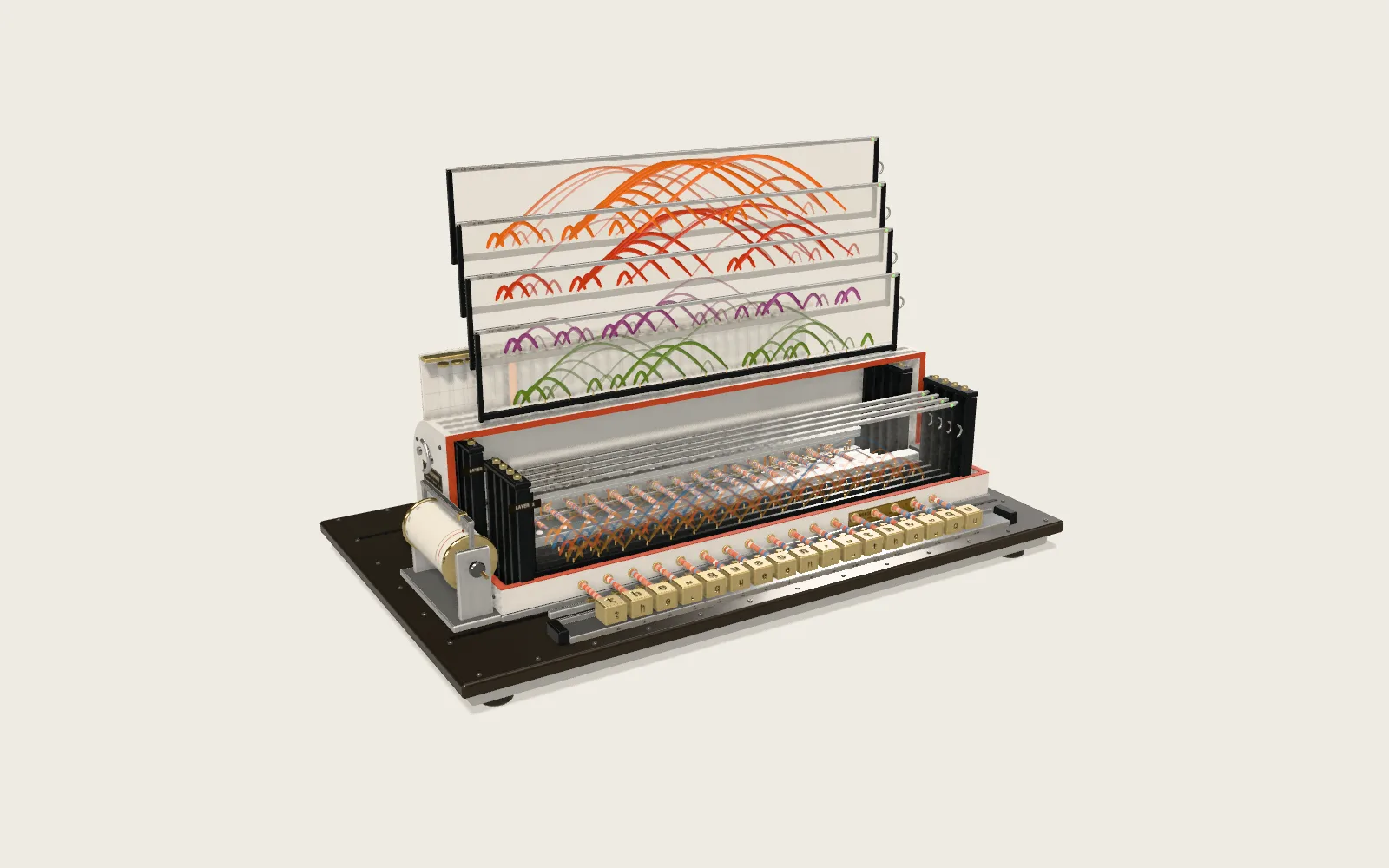 Plate F13Attention in TransformersA two-layer, eight-head Transformer reads a sentence in your browser, one character at a time, and guesses the next. Each thread is one act of attention; its brightness is the weight.
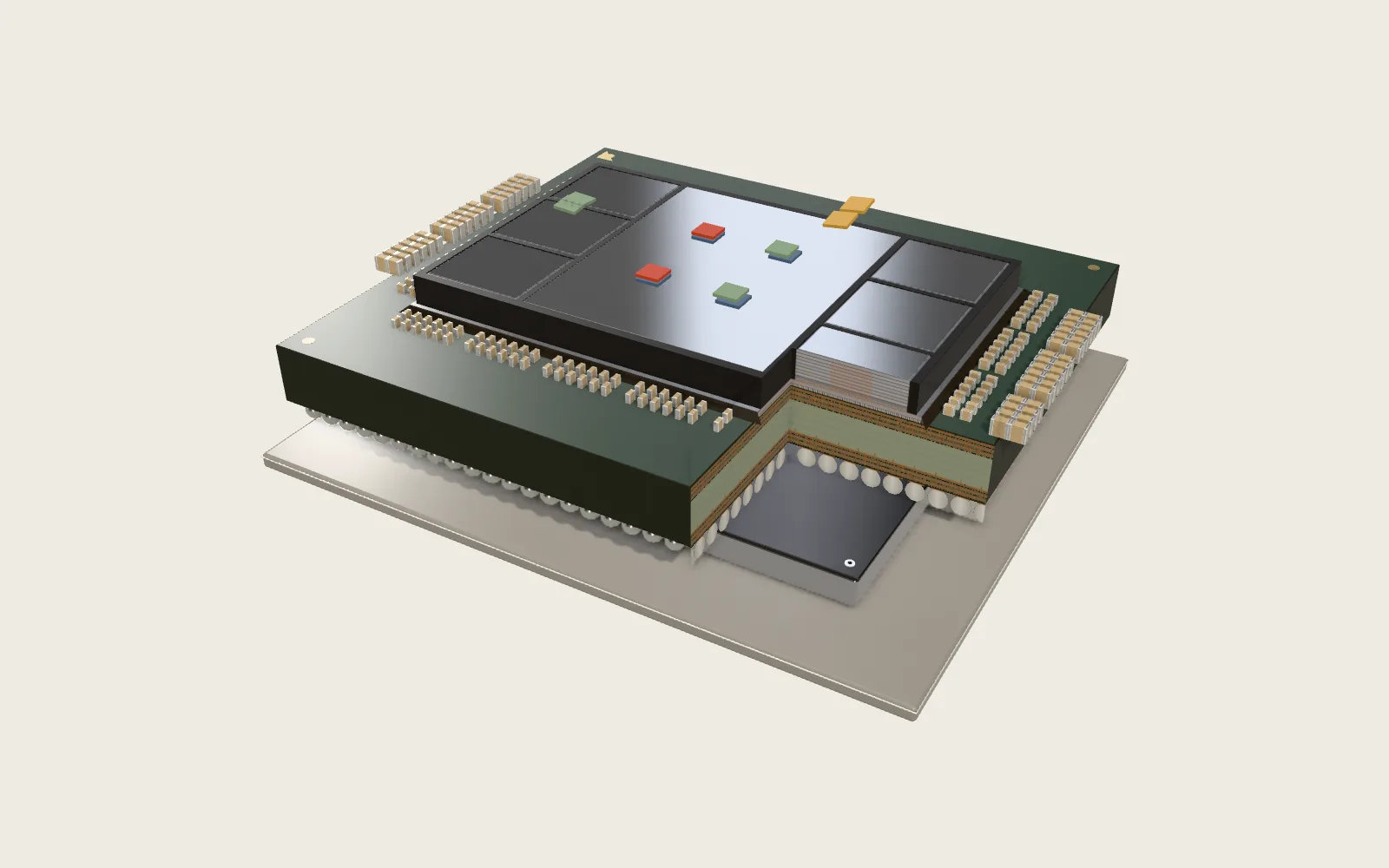 Plate F51FlashAttention and GPU MemoryDone the standard way, attention in a Transformer is slow on a GPU less because of its arithmetic than because an N × N matrix of scores is written to memory and read back. FlashAttention cuts the work into blocks, finishes each in the chip’s shared memory and keeps a running softmax, so it gets the same result while that matrix never goes to memory.
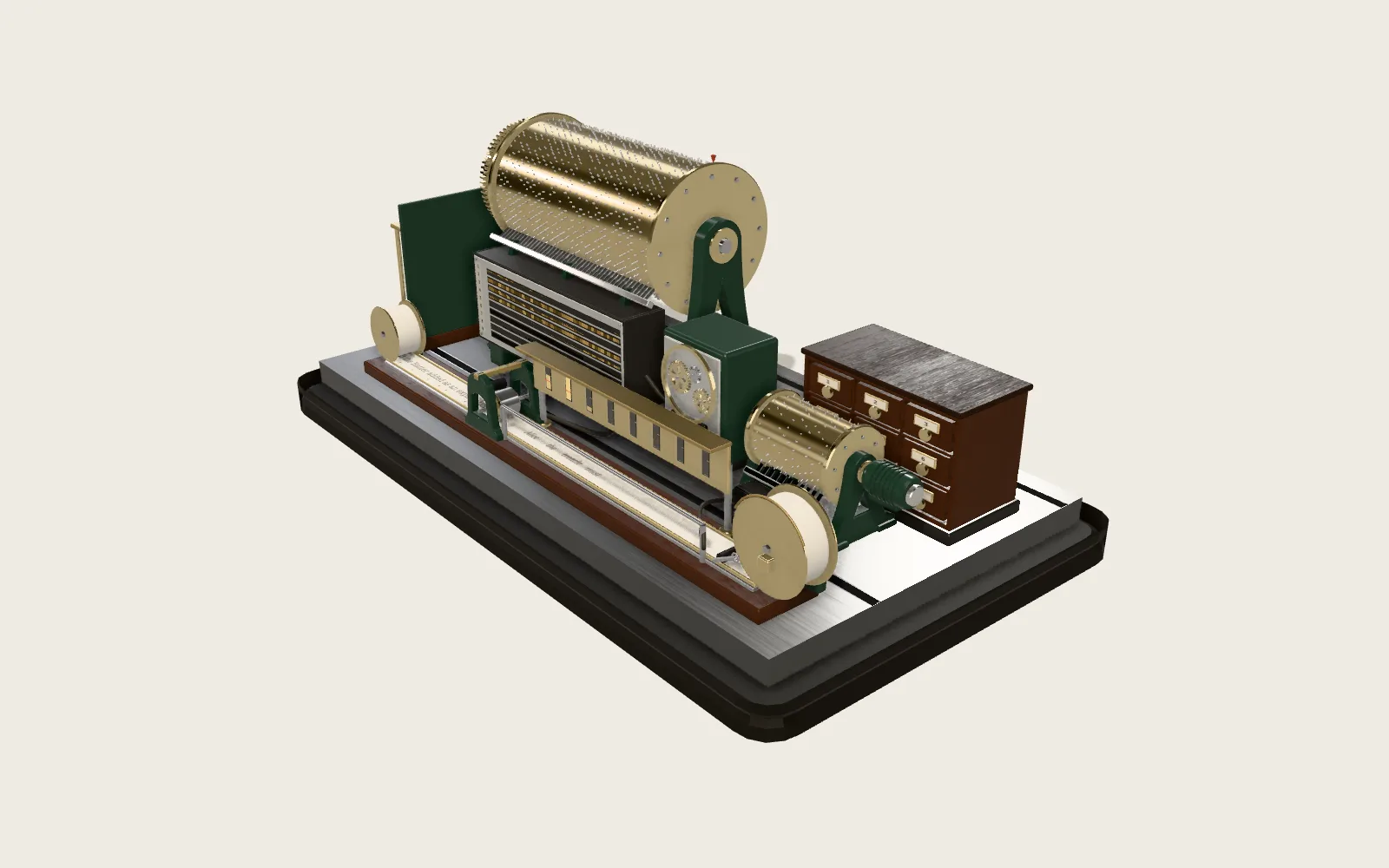 Plate F33Speculative DecodingA large model writes one token at a time, and for each one it reads all its weights out of memory: the time goes on reading, not on arithmetic. In speculative decoding a small model guesses a few tokens ahead and the large model checks them all in one read, and the text comes out with exactly the distribution the large model would give on its own. Both models and every number on the bench are computed in your browser.
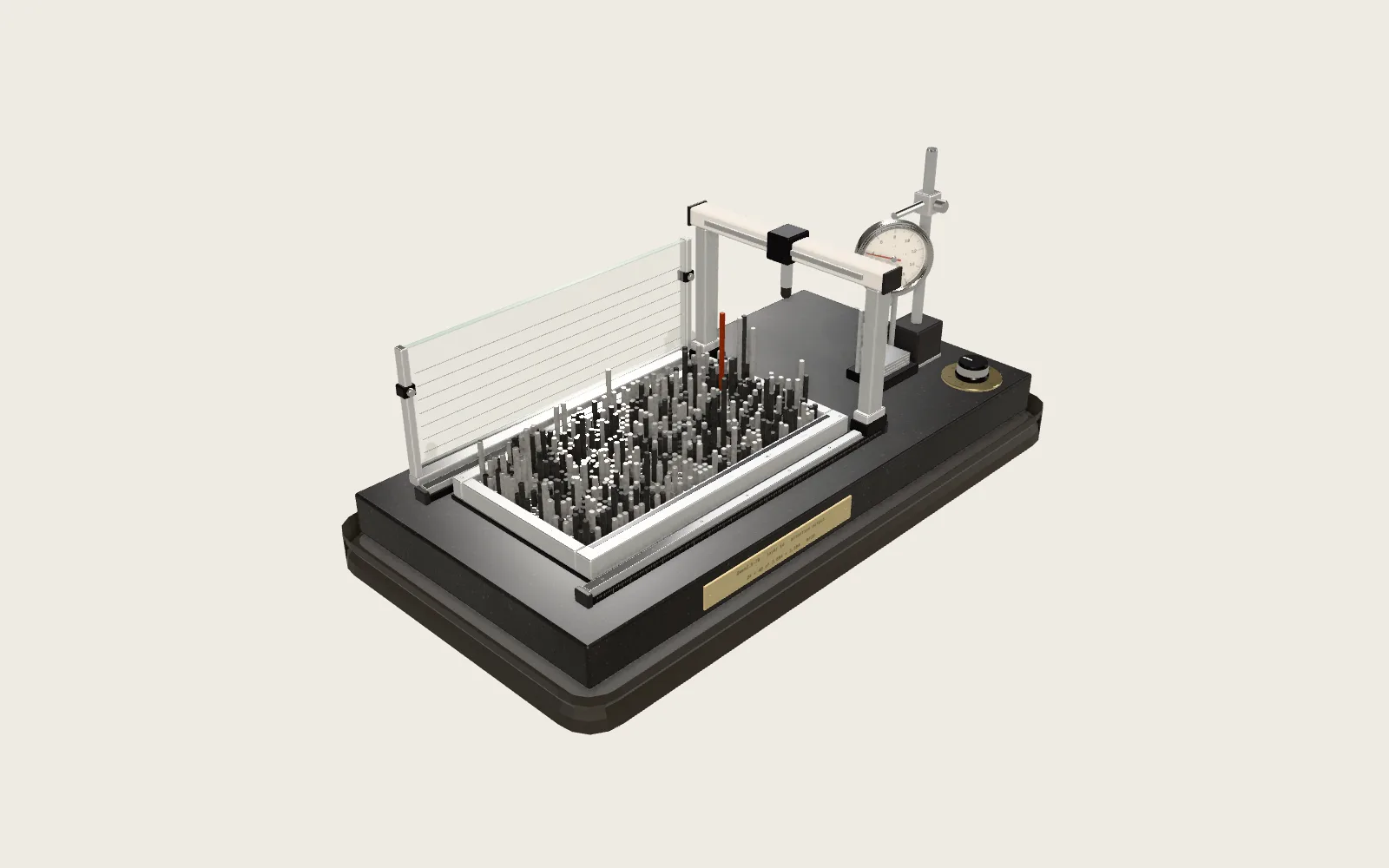 Plate F43LLM QuantizationA language model’s weights are stored with 16 bits each. Quantizing rounds them onto a coarser grid: 8 bits, 4, or only −1, 0 and +1. The model gets several times smaller and faster to read, at a cost in accuracy.
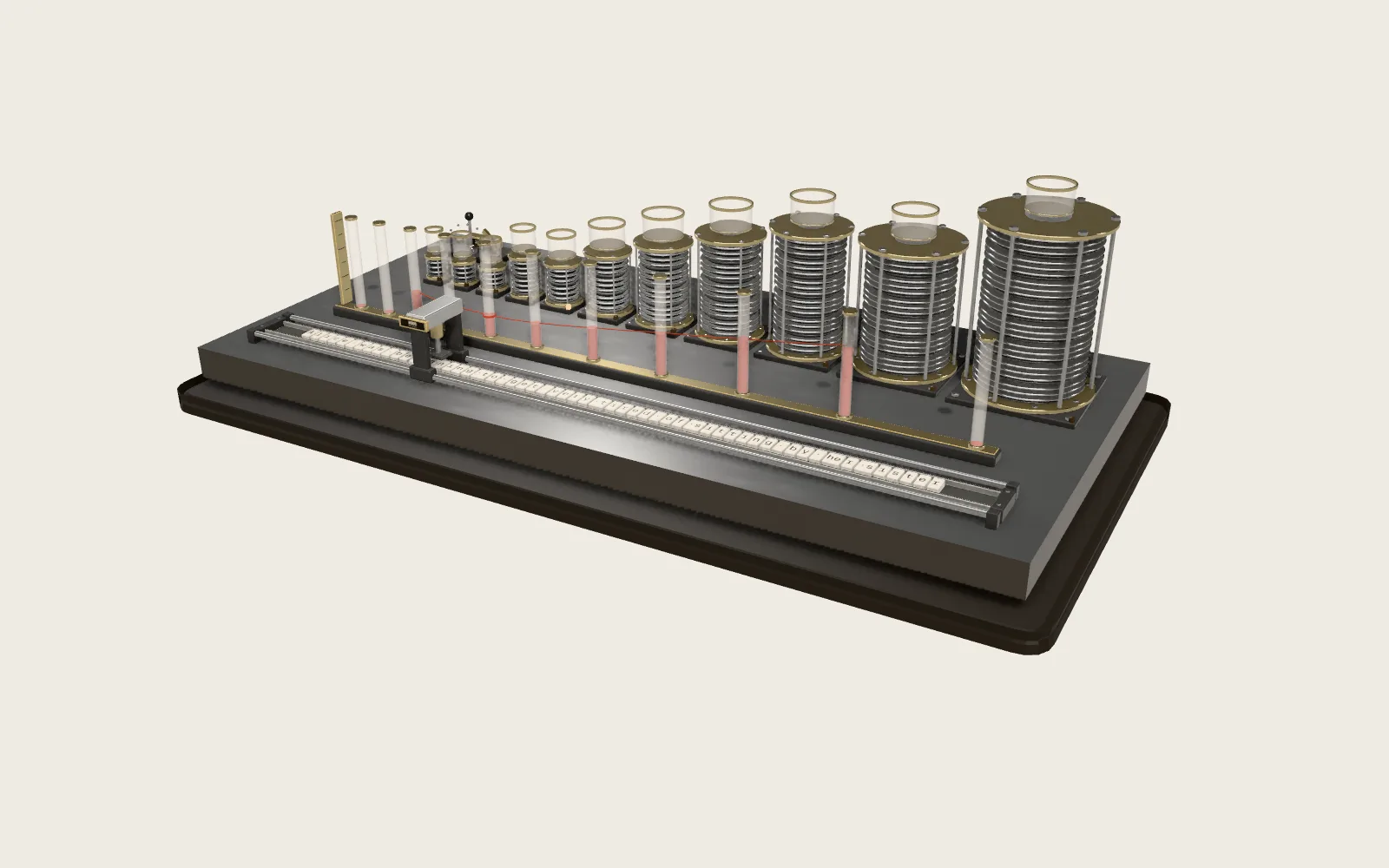 Plate F26Tokens and Scaling LawsLanguage models read tokens, not letters. Make a model bigger and give it more tokens, and its error falls along a power law. Here: byte-pair encoding running in your browser, and a family of small models that were really trained.