Patterns Shaken Out of Oil
A thin layer of oil sits on a shaker, moving up and down. At low acceleration the surface stays flat; past a threshold it breaks into a regular pattern. Each time the pattern rises and falls, the dish has gone up and down twice.
Scroll
Wrinkled Water, 1831
In 1831 Michael Faraday published a long paper on vibrating surfaces in the Philosophical Transactions of the Royal Society. He put water, milk, white of egg, ink and mercury on a vibrating plate and saw the liquid wrinkle into small, regular cells.
He counted carefully: each little heap formed again only once for every two vibrations of the plate. The liquid moved at half the plate’s frequency.
Model: an aluminium bath 180 mm across inside, with 4 mm of silicone oil, on an electrodynamic shaker
Half the Frequency
The dish goes up, down, up and down before a crest on the surface is back where it started. Two shakes of the dish, one rise and fall of the oil. This is a subharmonic response.
The real motion is too fast to follow: the dish shakes 80 times a second and the surface rises and falls 40 times. Here it is slowed many times over, and the dish’s travel is drawn larger than life.
Slowed down; the dish’s travel exaggerated
Like a Swing
Someone on a swing crouches at the top and stands at the bottom, twice in every full swing. The swing goes higher with no one pushing it. This is parametric resonance: what changes is a property of the system itself, not a push from outside.
A shaken dish works the same way. Seen from the dish, gravity grows and shrinks once with every shake. A ripple that rises and falls on its own, with a period of exactly two shakes, is strengthened again and again.
In 1954 Brooke Benjamin and Fritz Ursell wrote the equation for this: a ripple of each wavelength obeys a Mathieu equation. Its solutions grow inside a series of tongue-shaped regions. The widest is where the ripple’s frequency is half the shaking frequency.
A Threshold
Without friction, even the gentlest shaking would slowly grow the matching ripple. Oil is viscous and a ripple loses energy all the time. It grows only if the shaking puts in more than it loses.
So the pattern has a threshold acceleration. For 20 cSt silicone oil shaken at 80 Hz, the measured threshold is 4.2 times gravity. Below it the surface is flat; above it the pattern fills the dish within seconds.
Stripes, Squares, Hexagons
Just past the threshold, the surface is a few sets of standing waves laid on top of each other. How many sets and in which directions sets the pattern: one set makes stripes, two at right angles make squares, three at 60 degrees make hexagons.
Which one appears depends on the oil’s viscosity and the frequency. In 1996 Arshad Kudrolli and Jerry Gollub mapped it in a dish 32 cm across: below about 25 Hz mostly hexagons; at higher frequencies, squares in thin oil and stripes in thick oil.
Faster Shaking, Shorter Waves
The spacing of the pattern is set by the waves on the oil. A wave’s frequency and its length are tied together: long waves are pulled flat by gravity, short ones by surface tension.
The faster the shaking, the shorter the wave that is picked. On silicone oil, shaking at 20 Hz gives waves about 18 mm long; at 80 Hz, about 4.8 mm. Above about 40 Hz, surface tension matters more than gravity.
Two Frequencies
Shake with two frequencies at once and the pattern can be richer. In 1993 William Edwards and Stéphan Fauve shook a layer of 100 cSt oil at two frequencies and, at certain ratios, saw a pattern with twelvefold symmetry that never repeats.
It is like a two-dimensional quasicrystal: turned through 30 degrees it looks the same, but no shift lines it up with itself. Drawn here: six sets of standing waves, 30 degrees apart.
A Drop That Does Not Land
Below the threshold the surface stays flat. Dip a toothpick into the oil and pull it out, and it leaves a drop less than a millimetre across. The drop falls onto the shaking surface, and instead of merging, it bounces.
Each time it comes down, a thin film of air is trapped between drop and bath. Before the air can drain away, the drop is thrown up again. It can bounce like this for a long time, and every landing sends a small ring of waves across the surface.
Drop 0.8 mm across; magnified and slowed down
A Drop That Walks
The closer the shaking is to the threshold, the longer the drop’s waves last. Close enough, the drop lands on the slope of the wave it made last time and is pushed to one side. It starts to walk across the bath, about a centimetre a second.
In 2005 Yves Couder and his colleagues reported these walking drops. What drives a drop is the wave it leaves behind, and that wave keeps a record of where it has been. The nearer the threshold, the longer the memory.
20 cSt silicone oil at 80 Hz, just below threshold; the drop’s waves exaggerated
An Analogy
A particle guided by its own wave recalls Louis de Broglie’s pilot-wave picture of quantum mechanics. Walking drops show some quantum-like behaviour: in a rotating bath their circular orbits come only in certain sizes, and a drop sometimes crosses a shallow barrier.
But this is not quantum mechanics. It happens on a flat surface only; the wavelength is set by the shaking, not by how fast the drop moves; and later, more careful experiments did not reproduce an early report of double-slit interference. It is a classical analogy you can see, a help for thinking, not an explanation.
The Bench
Frequency runs from 15 to 120 Hz and acceleration from 0 to 12 times gravity. The stability chart beside it marks where you are: inside a tongue, a pattern grows. The oil comes in four viscosities, and a second frequency can be added.
Try thisWith 20 cSt oil at 80 Hz, raise the acceleration slowly: at how many g does the pattern appear? Drop the frequency to 40 Hz: what are the threshold and the wavelength now?
What the model leaves out
The threshold and the stability chart come from the Mathieu equation with a linear viscous damping (2νk²), solved numerically by Floquet’s method for each wavelength. A real viscous fluid does not reduce exactly to that equation (Kumar and Tuckerman 1994), and at high viscosity it overestimates the threshold: for 20 cSt at 80 Hz the model gives about 5.3 g against the measured 4.2 g. The pattern is an amplitude-equation model: standing waves in 24 directions that hold each other back according to the angle between them. Those couplings are not derived from the fluid equations; they are chosen so that the pattern the experiments report wins. So the model gets the symmetries right but does not predict which pattern appears. The patterns here are centred on the dish; real ones have defects, bend near the wall, and turn into disordered waves far above threshold. The drop follows a simplified stroboscopic model: it lands once per Faraday period, leaves a decaying Bessel wave where it lands and is pushed by the slope of the waves already there; the wall is a soft inward push, while real drops are turned by waves the wall reflects. Real motion is too fast and too small to see, so it is slowed down, and in some chapters exaggerated.
A common mistake
Walking drops are often described as macroscopic quantum particles. They share some statistical behaviour, but the mechanism is different: the wavelength does not change with speed, there is no entanglement, and the double-slit interference reported in 2006 was later questioned by more careful experiments (Andersen et al. 2015; Pucci et al. 2018). Also, Faraday waves are not a resonance of the dish itself: shaken hard enough, a pattern appears at any frequency, and the frequency only sets its spacing.
Sources
- Faraday (1831): On a peculiar class of acoustical figures…, Phil. Trans. 121
- Faraday (1831), full text (OCR), paragraphs 101 and 108
- Benjamin & Ursell (1954): The stability of the plane free surface of a liquid in vertical periodic motion
- Kumar & Tuckerman (1994): Parametric instability of the interface between two fluids
- Kudrolli & Gollub (1996): Patterns and spatiotemporal chaos in parametrically forced surface waves
- Edwards & Fauve (1993): Parametrically excited quasicrystalline surface waves
- Edwards & Fauve (1994): Patterns and quasi-patterns in the Faraday experiment
- Couder et al. (2005): From bouncing to floating
- Couder et al. (2005): Walking and orbiting droplets, Nature
- Fort et al. (2010): Path-memory induced quantization of classical orbits
- Bush (2015): Pilot-wave hydrodynamics, Annu. Rev. Fluid Mech.
- Andersen et al. (2015): Double-slit experiment with single wave-driven particles
- Pucci et al. (2018): Walking droplets interacting with single and double slits
Data
Michael Faraday, On a peculiar class of acoustical figures; and on certain forms assumed by groups of particles upon vibrating elastic surfaces (Phil. Trans. R. Soc. Lond. 121, 299–340, 1831). T. Brooke Benjamin and F. Ursell, The stability of the plane free surface of a liquid in vertical periodic motion (Proc. R. Soc. Lond. A 225, 505–515, 1954). Krishna Kumar and Laurette S. Tuckerman, Parametric instability of the interface between two fluids (J. Fluid Mech. 279, 49–68, 1994). Pattern map after A. Kudrolli and J. P. Gollub, Patterns and spatiotemporal chaos in parametrically forced surface waves (Physica D 97, 133–154, 1996), table 1. Quasipatterns: W. S. Edwards and S. Fauve (Phys. Rev. E 47, R788, 1993; J. Fluid Mech. 278, 123–148, 1994). Bouncing and walking drops: Y. Couder, E. Fort, C.-H. Gautier and A. Boudaoud (Phys. Rev. Lett. 94, 177801, 2005); Y. Couder, S. Protière, E. Fort and A. Boudaoud, Walking and orbiting droplets (Nature 437, 208, 2005); E. Fort, A. Eddi, A. Boudaoud, J. Moukhtar and Y. Couder (PNAS 107, 17515, 2010); John W. M. Bush, Pilot-wave hydrodynamics (Annu. Rev. Fluid Mech. 47, 269–292, 2015); A. Andersen et al. (Phys. Rev. E 92, 013006, 2015); G. Pucci, D. M. Harris, L. M. Faria and J. W. M. Bush (J. Fluid Mech. 835, 1136–1156, 2018). The model, the simulation and the words are the site’s own.
The text, pictures and models on this page are licensed CC BY-NC 4.0: free to use and adapt for teaching and other non-commercial purposes, with credit to world.lapla.si. Third-party material listed above keeps its own licence.
Follow the question
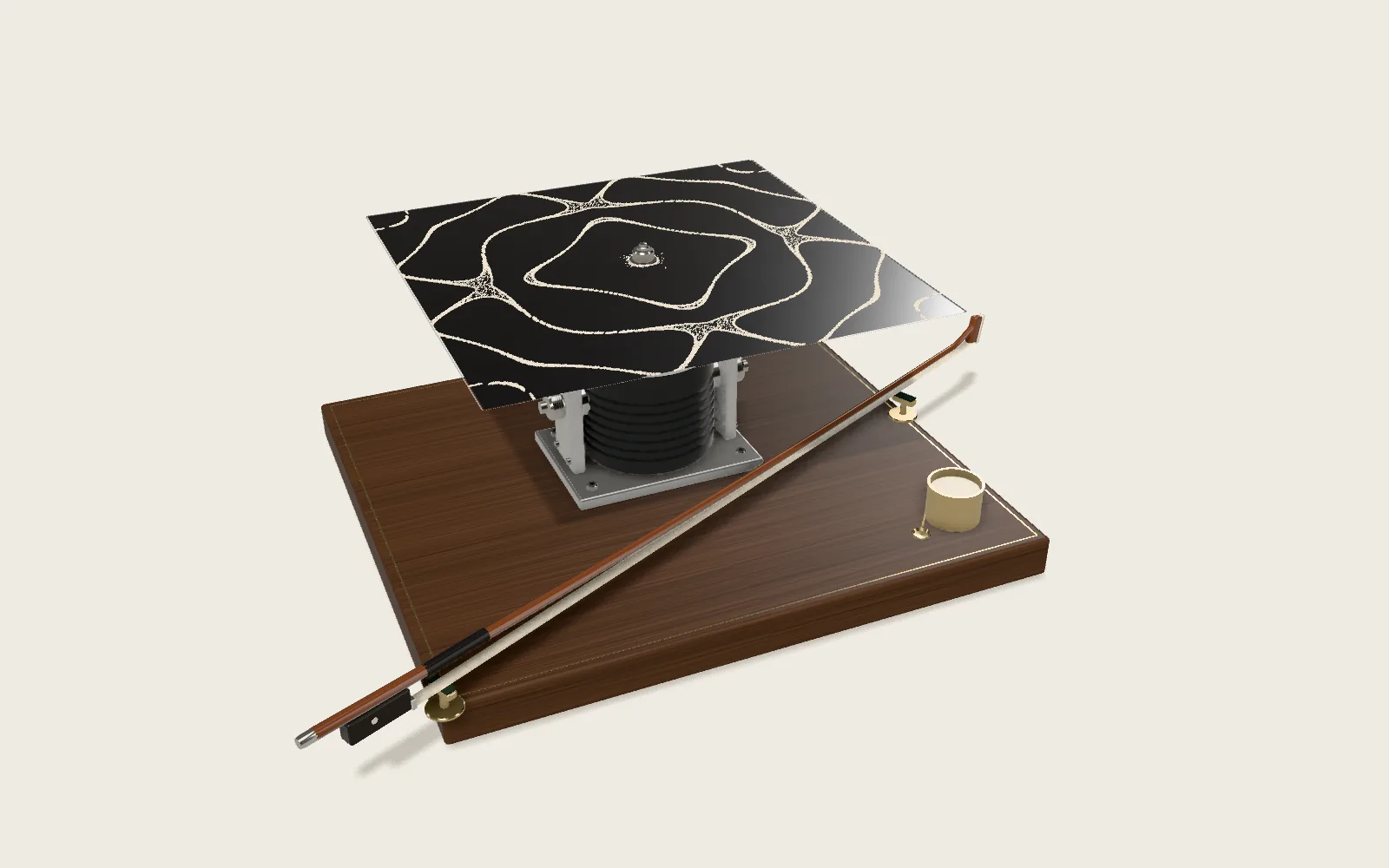 Plate 47Sand That Draws a SoundSprinkle sand on a metal plate and make it ring. The sand jumps away from the moving parts and gathers on the lines that stay still, drawing the shape of the vibration.
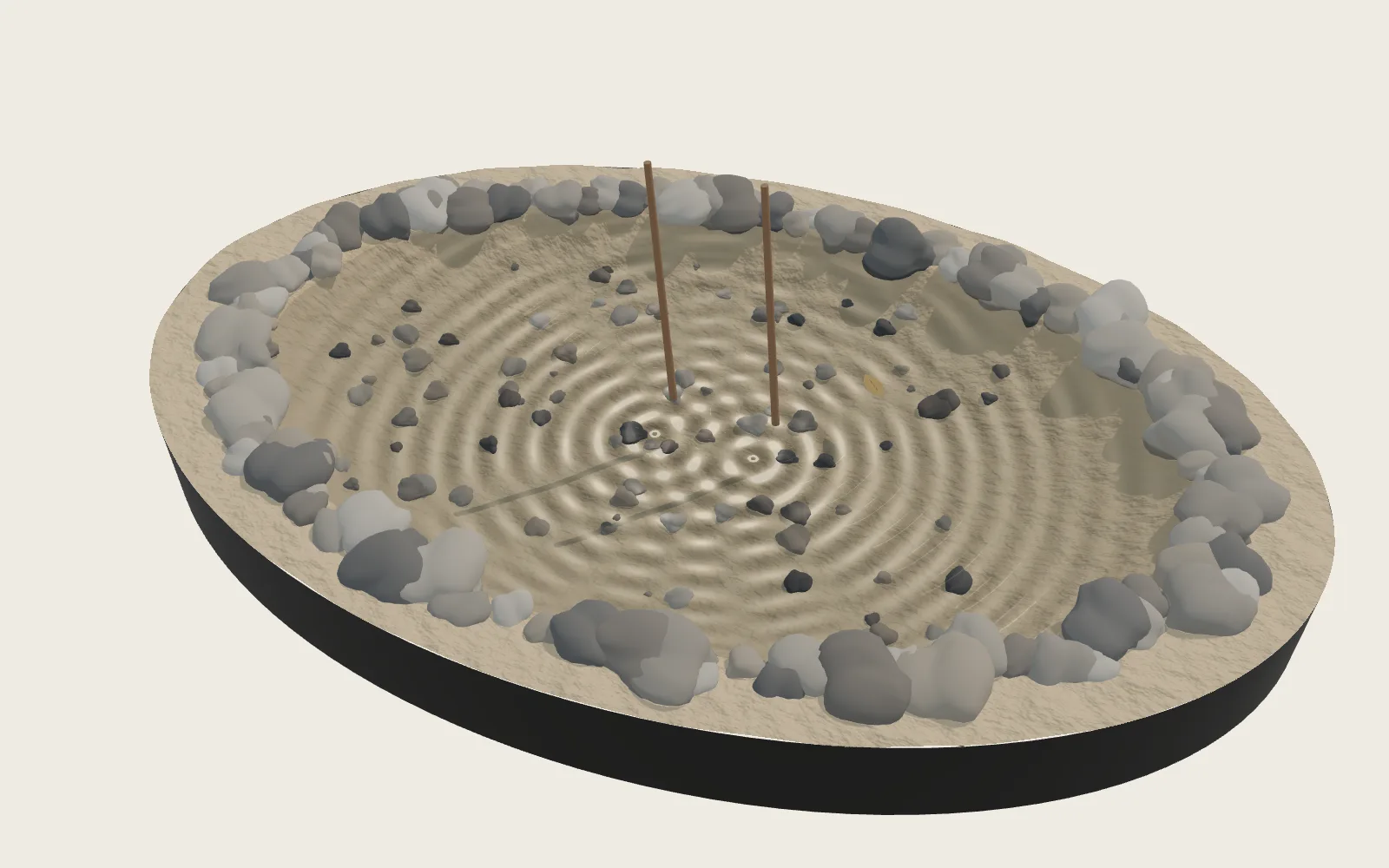 Plate 37When Two Ripples MeetDrop two stones in water and their rings of ripples pass straight through each other. In some places they cancel out, and the water there barely moves.