Hearing a Moth in the Dark
A pipistrelle flies at night, calling about ten times a second. Its calls are above human hearing and bounce back off a moth. However many milliseconds the echo takes, that is how far away the moth is.
Scroll
Calls No One Heard
In 1793 Lazzaro Spallanzani found that blinded bats still flew around a room without hitting anything. His contemporary Louis Jurine, in Geneva, found that bats with plugged ears crashed. Bats found their way by ear, yet no one could hear them make a sound.
In 1938 Donald Griffin, a student at Harvard, took bats to the physicist G. W. Pierce, who had built a detector for ultrasound. Their calls were recorded for the first time. In 1944 Griffin named the skill: echolocation.
Model: a common pipistrelle and a noctuid moth, about 16 times life size; the distance between them is not to scale
One Call
A common pipistrelle searching in the open makes calls about 6 milliseconds long: the frequency sweeps down from fifty or sixty kilohertz and levels out near 45 kHz. Human hearing stops at about 20 kHz.
Bats that hunt insects in the open air call loudly: 120 to more than 130 decibels, measured 10 cm in front of the mouth. The call leaves through the open mouth and goes mostly forward.
Sound travels 343 metres a second. A call 6 milliseconds long is stretched out in the air into a train of waves about 2 metres long.
Sound slowed about 300 times; the crests drawn at the real wavelength, enlarged like the model
The Late Echo
When the call meets a moth, a small part of it bounces back. The echo makes a round trip: from a moth 1 metre away it arrives 5.8 milliseconds later; from 2 metres, 11.7 milliseconds.
The bat reads the distance from this delay. In experiments in 1973, bats told apart distances 1 to 3 centimetres different, a difference of less than 0.2 milliseconds in the echo’s timing.
The echo is far weaker than the call. Sound spreads out as it travels, so it weakens once on the way out and again on the way back, and the air absorbs some of it.
Red: the moth’s echo. The readout is a spectrogram: time across, frequency up
Why Ultrasound
When a wave meets something much smaller than its wavelength, the echo is disproportionately weak. At 45 kHz the wavelength is about 7.6 mm, smaller than a moth; at 20 kHz it is about 17 mm, as big as a small moth. The higher the frequency, the clearer the echo from a small insect.
The price is range. Air absorbs high frequencies more strongly: at 20 °C and 50% humidity, about 1.5 dB per metre at 45 kHz and about 3.3 dB per metre at 100 kHz. The higher the call, the shorter the distance at which prey stands out.
Crest spacing is the real wavelength, at the moth’s scale; cycling through 20, 46 and 100 kHz
Two Ears
The bat also needs to know which way the moth is. An echo from one side reaches the nearer ear first. But a bat’s head is small: a big brown bat’s ears are about 12 mm apart, so the difference is at most about 35 microseconds.
Loudness is the more useful cue. The outer ear works like a forward-facing horn and is very directional at high frequencies: the ear on the side of the echo hears it louder.
The small flap in front of the ear opening, the tragus, helps with up and down. In a 1982 experiment, big brown bats told apart heights about 3 degrees apart; with the tragus glued aside, it took 12 to 14 degrees.
A Wing Made of a Hand
A bat’s wing is a hand. The upper arm is short and the forearm long, just over 3 cm in a common pipistrelle. The thumb stays free on the leading edge with a small claw; the other four fingers are very long and spread a thin skin. The wings span 20 to 23 cm, and the bat weighs a few grams.
The skin runs from the fifth finger to the body and the hind leg; between the legs is a tail membrane, held out by a spur of cartilage from the ankle called the calcar. Pipistrelles often scoop insects up with the tail membrane or a wingtip.
While searching it calls once with every wingbeat. Calls are timed with the wingbeat and the outward breath, so they cost almost nothing extra.
Search, Approach, the Final Buzz
Searching, a pipistrelle calls about 10 times a second. It detects an insect 1 to 2 metres away and starts the approach: calls come faster and each one gets shorter, from 4–7 ms down to just over 2 ms. Short calls keep each call clear of its own echo, which comes back sooner and sooner.
About half a metre from the insect the calls run together into a buzz, the feeding buzz. In the last 20 cm or so the bat calls nearly 200 times a second, each call only half a millisecond long and lower in pitch. The whole buzz lasts little more than a tenth of a second. A few centimetres from the insect the bat falls silent and scoops it up.
Flight slowed about 7 times; in this chapter the speed of sound is not to scale
Horseshoe Bats Retune
Horseshoe bats call differently: each call lasts tens of milliseconds at an almost constant frequency, about 83 kHz in the greater horseshoe bat.
Flying forward, the echoes from ahead come back higher because of the Doppler effect. The horseshoe bat lowers its own call just enough to cancel this, so the echo lands on one narrow frequency where its hearing is sharpest, to within a tenth or two of a percent. Hans-Ulrich Schnitzler found this Doppler compensation in 1968.
An insect beating its wings makes the echo flicker in pitch and loudness. Listening at that fixed frequency, the horseshoe bat picks out these flickers and finds a flying insect among the echoes of leaves.
The bat’s speed is exaggerated so the squeeze of the wavefronts shows; the readout assumes a flight speed of 4 m/s
The Moth Can Hear
Many noctuid moths have an ear on each side of the hind thorax: a thin eardrum with only two auditory cells beneath it, one sensitive and one much less so. It cannot tell pitch, but it is very sensitive to bat ultrasound.
In the 1960s Kenneth Roeder found that noctuids hear a bat long before the bat can detect them. At a faint, distant call a moth turns and flies away; when the call suddenly gets loud, the bat is within a few metres, and the moth folds its wings and spirals down.
Some tiger moths answer back. In 2009 an experiment showed one species clicking ultrasound rapidly once a big brown bat had locked on to it, jamming the bat’s ranging so that it missed.
The moth’s ears are on the sides of the hind thorax, in front of the waist; it folds its wings as it drops
The Bench
Drag the moth anywhere on the plinth. Frequency runs from 15 to 120 kHz, call length from 0.3 to 20 ms, and from 5 to 200 calls a second. The readout draws the calls and their echoes and says whether the echo can be used: too faint, overlapping the call, or back only after the next call has gone.
Try thisSet the call to 20 ms and drag the moth slowly closer: within what range does the echo overlap the call?
What the model leaves out
The bat and the moth are about 16 times life size and the distance between them is compressed; sound is slowed several hundred times, the hunt’s flight about 7 times, and in that chapter the speed of sound is not to scale. Crests are drawn at the call’s final frequency, while a real call sweeps and its wavelength changes as it goes. The echo’s strength comes from a simple sonar equation: spherical spreading out and back, air absorption from ISO 9613-1 (20 °C, 50% humidity), and the moth taken as a rigid sphere 5 mm in radius, weakened by Rayleigh scattering when it is small next to the wavelength; the call is 120 dB at 10 cm and the threshold 0 dB (Kick 1982 found the big brown bat’s echo threshold near 0 dB). It ignores the directionality of the call and the ears, clutter, and the bat’s ability to detect echoes in noise, so the detection ranges it gives are only the right size. The hunt’s calls follow the typical pipistrelle numbers reported by Kalko (1995), not a single recording.
A common mistake
Bats are not blind. Every bat has eyes and many see well; the large fruit bats rely mostly on sight and smell, and most of them do not echolocate. Also, insects smaller than the wavelength are not invisible to a bat, their echoes are just much weaker; bats calling at low frequencies sometimes catch small insects too.
Sources
- Pierce & Griffin (1938): Experimental determination of supersonic notes emitted by bats
- Griffin & Galambos (1941): The sensory basis of obstacle avoidance by flying bats
- Griffin (1944): Echolocation by blind men, bats and radar, Science 100
- Griffin (2001): Return to the magic well (a retrospective, with Spallanzani and Jurine)
- Kalko & Schnitzler (1993): Plasticity in echolocation signals of European pipistrelle bats in search flight
- Kalko (1995): Insect pursuit, prey capture and echolocation in pipistrelle bats
- Schnitzler & Kalko (2001): Echolocation by insect-eating bats, BioScience
- Surlykke & Kalko (2008): Echolocating bats cry out loud to detect their prey
- Kick (1982): Target-detection by the echolocating bat, Eptesicus fuscus
- Simmons (1973): The resolution of target range by echolocating bats
- Lawrence & Simmons (1982): Measurements of atmospheric attenuation at ultrasonic frequencies
- Lawrence & Simmons (1982): The external ear and perception of the vertical positions of targets, Science
- Sayegh, Aubie & Faure (2014): interaural distance and time difference in the big brown bat
- Schnitzler (1968): The ultrasonic calls of horseshoe bats in different situations
- Schnitzler & Denzinger (2011): Auditory fovea and Doppler shift compensation (review)
- Suthers et al. (1972): Respiration, wing-beat and ultrasonic pulse emission in an echo-locating bat
- Speakman & Racey (1991): No cost of echolocation for bats in flight, Nature
- Roeder (1966): Auditory system of noctuid moths, Science
- Wakefield et al. (2015): moths turning away and diving from ultrasound
- Goerlitz et al. (2010): moths hear bats more than 30 m away, Current Biology
- Corcoran, Barber & Conner (2009): Tiger moth jams bat sonar, Science
- Bat Conservation Trust: common pipistrelle measurements
- ISO 9613-1: Attenuation of sound during propagation outdoors, part 1
Data
Echolocation: G. W. Pierce and D. R. Griffin (J. Mammal. 19, 454–455, 1938); D. R. Griffin and R. Galambos (J. Exp. Zool. 86, 481–506, 1941); Donald R. Griffin, Echolocation by blind men, bats and radar (Science 100, 589–590, 1944) and Return to the magic well (BioScience 51, 555–556, 2001). Pipistrelle calls and the phases of a hunt: E. K. V. Kalko and H.-U. Schnitzler (Behav. Ecol. Sociobiol. 33, 415–428, 1993); E. K. V. Kalko (Anim. Behav. 50, 861–880, 1995); H.-U. Schnitzler and E. K. V. Kalko, Echolocation by insect-eating bats (BioScience 51, 557–569, 2001). Loudness: A. Surlykke and E. K. V. Kalko (PLoS ONE 3, e2036, 2008). Detection and ranging: S. A. Kick (J. Comp. Physiol. 145, 431–435, 1982); J. A. Simmons (J. Acoust. Soc. Am. 54, 157–173, 1973). Absorption: B. D. Lawrence and J. A. Simmons (J. Acoust. Soc. Am. 71, 585–590, 1982) and ISO 9613-1. The tragus: B. D. Lawrence and J. A. Simmons (Science 218, 481–483, 1982). Interaural distance: R. Sayegh, B. Aubie and P. A. Faure (Front. Physiol. 5, 215, 2014). Doppler compensation: H.-U. Schnitzler (Z. vergl. Physiol. 57, 376–408, 1968); H.-U. Schnitzler and A. Denzinger (J. Comp. Physiol. A 197, 541–559, 2011). Calls, wingbeat and breathing: R. A. Suthers, S. P. Thomas and B. J. Suthers (J. Exp. Biol. 56, 37–48, 1972); J. Speakman and P. A. Racey (Nature 350, 421–423, 1991). Pipistrelle measurements: Bat Conservation Trust. Moths: K. D. Roeder, Auditory system of noctuid moths (Science 154, 1515–1521, 1966) and Nerve Cells and Insect Behavior (Harvard University Press); J. D. Wakefield et al. (R. Soc. Open Sci. 2, 150291, 2015); H. R. Goerlitz et al. (Curr. Biol. 20, 1568–1572, 2010); A. J. Corcoran, J. R. Barber and W. E. Conner, Tiger moth jams bat sonar (Science 325, 325–327, 2009). The model, the simulation and the words are the site’s own.
The text, pictures and models on this page are licensed CC BY-NC 4.0: free to use and adapt for teaching and other non-commercial purposes, with credit to world.lapla.si. Third-party material listed above keeps its own licence.
Follow the question
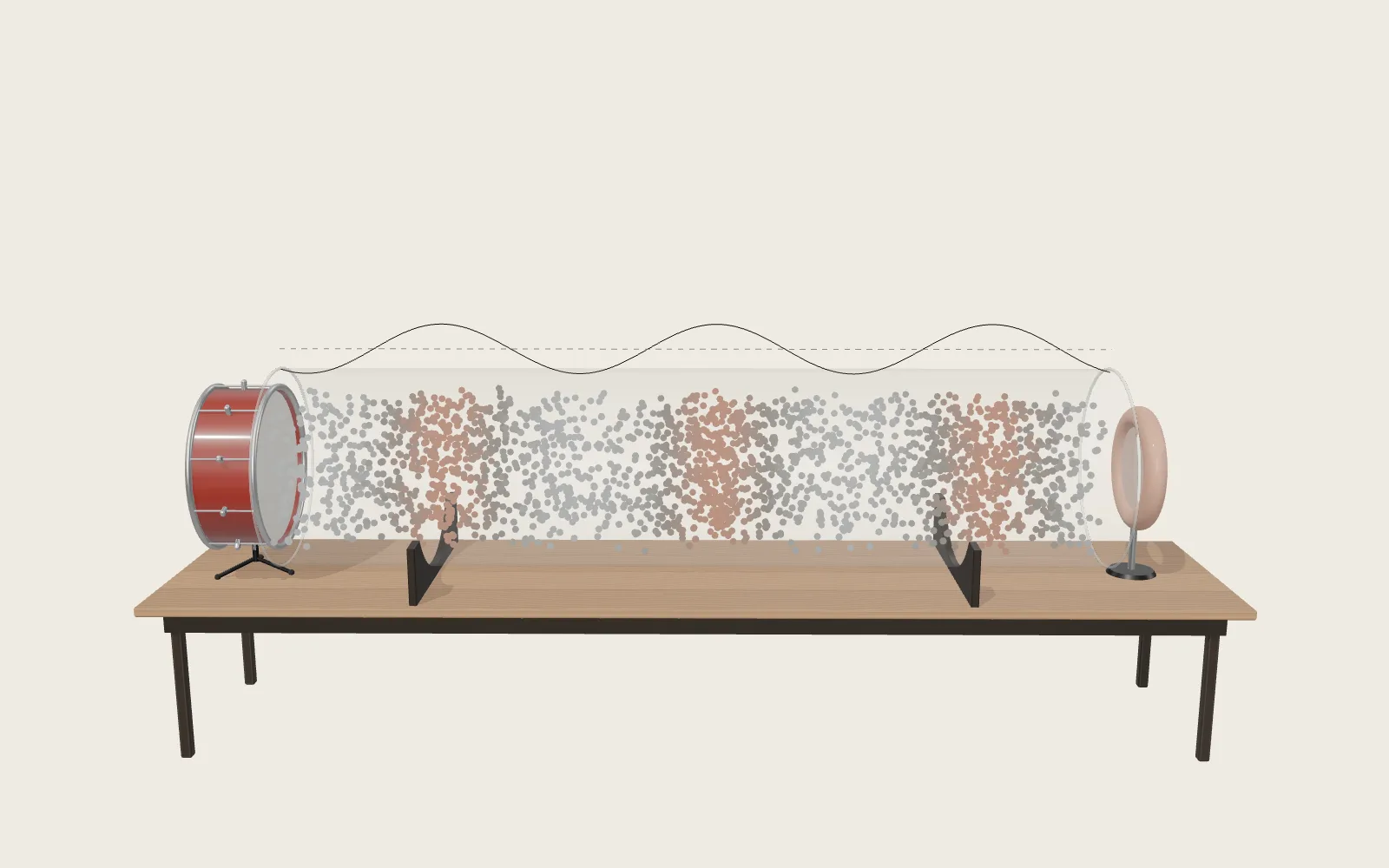 Plate 15How Sound Crosses the AirSound is a push passed along through the air. The air doesn’t travel to you; the push does.
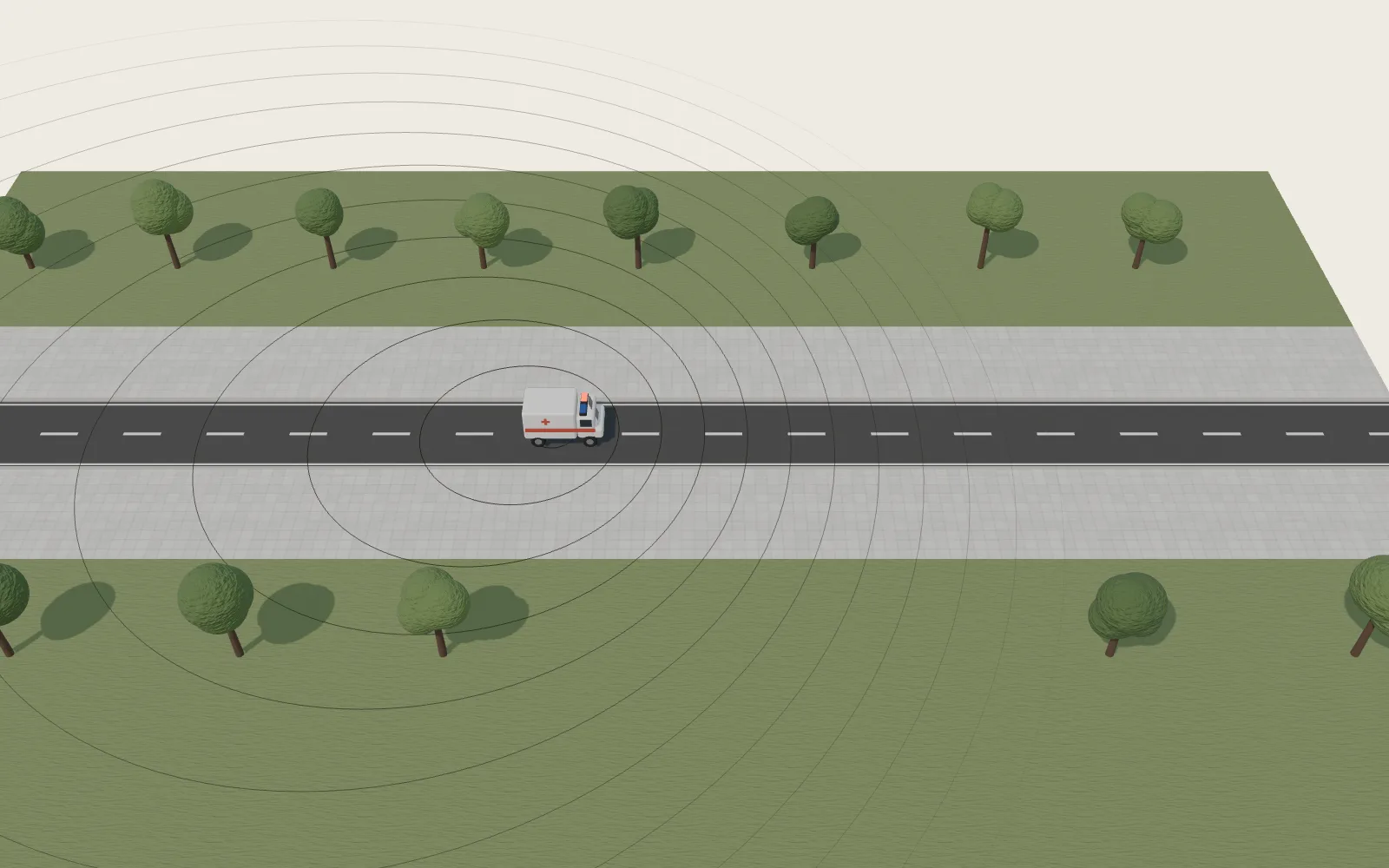 Plate 26Why a Siren Changes Its TuneAn ambulance sounds higher coming towards you and lower going away. The siren hasn’t changed; its sound waves have been squeezed or stretched.