Bromine from Seawater
Chlorine turns seawater’s bromide into bromine; air blows it out of a brick tower, and it is concentrated and condensed into a dark red-brown liquid.
Chapters · 13
- 01Bromine in a Kilogram of Sea
- 02Acid First, to pH 3.5
- 03Chlorine Takes the Electrons
- 04Air Up, Water Down
- 05Why Air Can Carry It
- 06Caught and Concentrated
- 07Chlorine and Steam Again
- 08A Dark Red-Brown Liquid
- 09How Much Sea for a Kilogram
- 10Kure Beach, 1934
- 11Where Bromine Comes From Now
- 12The Tower in Pieces
- 13Air, Warmth and Chlorine
Scroll
Bromine in a Kilogram of Sea
A kilogram of seawater holds about 35 g of salt. In the international reference composition about 67 mg of it is bromide, just 0.19 % of the salt; chloride outweighs it about 288 times (TEOS-10, computed here).
The bromine in seawater is not red-brown elemental bromine but the invisible bromide ion, Br⁻. Free bromine does not occur in nature; it is found only as bromide (HSDB).
There is little of it, but the sea is large: the USGS puts it at about 65 ppm, some 100 trillion tonnes in all. To take bromine from seawater, the bromide must first be turned into bromine, and then parted from a vast amount of water.
Br⁻ about 67 mg per kg of seawater · 0.19 % of the salt · chloride about 288 times as much by mass (computed)
Acid First, to pH 3.5
Seawater is slightly alkaline. Dow’s research found that in so dilute a solution freed bromine hydrolyses, 3Br₂ + 3H₂O → HBrO₃ + 5HBr, and goes back into solution (Stewart 1934).
Acid to pH 3–4 stops this; Dow took pH 3.5, about 0.13 kg of sulfuric acid per tonne of seawater (Stewart 1934, converted here). Chlorinated at pH 7.2 without acid, at most 39 % of the bromine can be freed, and up to 10 equivalents of chlorine are spent per mole of bromine (Dow patent US 1,917,762).
At Kure Beach the seawater was pumped up to the blowing-out tower through a vertical 42-inch rubber-lined pipe: 10 % sulfuric acid went in near its foot and the chlorine a little higher (Stewart 1934). On the model it is the riser at the tower’s front left.
3Br₂ + 3H₂O → HBrO₃ + 5HBr · pH 3.5 · about 0.13 kg of sulfuric acid per tonne of seawater · without acid: 39 % at most (Dow patent)
Chlorine Takes the Electrons
Chlorine goes into the acidified seawater: Cl₂ + 2Br⁻ → 2Cl⁻ + Br₂. Each chlorine molecule takes two electrons from two bromide ions; it becomes chloride, and the bromide becomes a bromine molecule.
Chlorine can oxidise bromide because it is the stronger oxidiser: its standard potential is +1.358 V, bromine’s +1.087 V (CRC). The 0.27 V between them gives an equilibrium constant of about 10⁹ (computed here), so the reaction runs almost to completion. Iodide is easier to oxidise than bromide; fluorine is the strongest oxidiser (+2.87 V).
About 15 % more chlorine than in theory is used (Ullmann’s). At Kure Beach the chlorine came in one-ton cylinders, and the dose was set by watching a platinum electrode’s potential (Stewart 1934). Chlorine itself can be made by electrolysing brine: see Electrolysis of Brine.
Cl₂ + 2Br⁻ → 2Cl⁻ + Br₂ · Cl₂ +1.358 V, Br₂ +1.087 V (CRC) · about 15 % excess chlorine
Air Up, Water Down
The freed bromine is still dissolved, less than 0.07 g in a litre. The seawater falls from the top of a tower while air rises from the bottom; in close contact with the air, the bromine evaporates into it (Dow patent US 2,143,223).
The blowing-out towers at Kure Beach were brick, with concrete floors and foundations. Distributor boxes and pipes at the top split the water into about 3,200 small streams; the tower was partitioned into narrow chambers filled with wood packing (Stewart 1934).
The air was not blown in but drawn up by fans at the far end of the absorption tower (Stewart 1934). In Dow’s experiments, counter-current air took a solution from 70 ppm of bromine down to 5 ppm.
Seawater down, air up · about 3,200 streams · in the laboratory: 70 ppm → 5 ppm (Stewart 1934)
Why Air Can Carry It
Bromine boils at 58.8 °C, and at 20 °C its vapour pressure is 23.3 kPa (ICSC). Chlorine is more volatile still, boiling at −34 °C.
The more direct number is Henry’s constant. From Sander’s compilation, at equilibrium a volume of water holds about 18 times as much bromine as the same volume of air at 25 °C, and about 29 times at 15 °C (computed here). So each volume of seawater needs more air than that to be blown clean.
Dow’s patent puts the air leaving the tower at 20,000 to 40,000 cubic feet per pound of bromine; from that this page estimates 75–170 volumes of air per volume of seawater. In summer Kure Beach first warmed the seawater in a large pond, which raised the efficiency (Stewart 1934): the warmer the water, the more readily bromine leaves it.
Boils at 58.8 °C · 23.3 kPa at 20 °C · water to air concentration at equilibrium: about 18 at 25 °C, 29 at 15 °C (computed)
Caught and Concentrated
The air leaving the tower holds very little bromine, about 0.4–0.8 g a cubic metre (Dow patent, converted here). It is first caught in a small stream of liquid, where it builds up.
A patent Dow filed in 1936 used sulfur dioxide in water instead: Br₂ + SO₂ + 2H₂O → 2HBr + H₂SO₄ (Octel Kuhlmann patent). The sulfur dioxide reduces the bromine back to bromide and becomes sulfuric acid. In that patent the liquor builds up to 120–150 g of HBr a litre, bromine about 1,700–2,150 times as concentrated as in seawater (computed here). The sulfuric acid made with it can go back to acidify the seawater (Dow patent).
Kure Beach in 1934 used soda ash solution: 3Na₂CO₃ + 3Br₂ → 5NaBr + NaBrO₃ + 3CO₂. Its absorption tower was brick too, divided into nine chambers that the air passed through one after another before the fans drew it out (Stewart 1934).
Br₂ + SO₂ + 2H₂O → 2HBr + H₂SO₄ · 1934: 3Na₂CO₃ + 3Br₂ → 5NaBr + NaBrO₃ + 3CO₂ · the liquor about 1,700–2,150 times seawater (computed)
Chlorine and Steam Again
The strong liquor goes to a steaming-out column and is chlorinated again, Cl₂ + 2HBr → 2HCl + Br₂, while steam is let in. The freed bromine rises with the steam to a condenser (Dow patent US 2,143,223).
In a separator the condensate parts into two layers: liquid bromine below, and water with bromine dissolved in it above, which goes back to be steamed again (Dow patent). Liquid bromine has a density of about 3.1 g per cubic centimetre, more than three times that of water (Merck).
The bromine is then usually dried over strong sulfuric acid and distilled (patent US 8,815,050). Soda-ash liquor takes another path: sulfuric acid turns its bromide and bromate back into bromine together, which steam then carries off (Stewart 1934).
Cl₂ + 2HBr → 2HCl + Br₂ · condensed, it parts in two: liquid bromine below · dried over strong sulfuric acid
A Dark Red-Brown Liquid
Bromine is one of two elements that are liquid at room temperature (USGS); the other is mercury.
Liquid bromine is dark red-brown, freezes at −7.2 °C and boils at 58.8 °C; it evaporates steadily at room temperature, and its red-brown vapour is about 5.5 times as heavy as air (ICSC, Merck). In the separator, a layer of water with bromine dissolved in it lies over the liquid, and its vapour over that.
Bromine is toxic and corrosive: breathing it can kill, and it burns skin and eyes severely (ICSC). NIOSH sets 3 ppm in air as immediately dangerous to life, and recommends at most 0.1 ppm for long exposure.
Melts at −7.2 °C · boils at 58.8 °C · about 3.10 g/cm³ · NIOSH: 0.1 ppm; 3 ppm immediately dangerous to life
How Much Sea for a Kilogram
A kilogram of seawater holds about 67 mg of bromine. Even taken out to the last trace, a kilogram of bromine needs about 14.9 tonnes of seawater (computed here).
In practice not all of it is recovered. An engineering analysis takes a typical recovery of 70 % (El-Hamouz and Mann, 2007); the North Carolina marker’s essay gives “2,000 gallons of sea water for one pound of bromine”, about 87 % (converted here). At 70–87 %, a kilogram of bromine takes 17–21 tonnes of seawater.
All that water has to be acidified first: at 0.13 kg of sulfuric acid a tonne and 90 % recovery, a kilogram of bromine needs about 2 kg of sulfuric acid put into the sea water (computed here). It also takes 0.44 kg of chlorine in theory, about 0.51 kg with the 15 % excess.
All recovered: 14.9 t of seawater per kg of bromine · 87 %: 17.1 t · 70 %: 21.2 t (computed)
Kure Beach, 1934
In 1826 Balard in Montpellier treated the mother liquor of the salt works with chlorine and got a very dark red liquid; his paper was titled “On a particular substance contained in sea water”. The name comes from the Greek for stench (RSC).
Herbert Dow applied in 1889 for a patent on blowing bromine out with air, granted in 1891 (US 460,370); his company worked the underground brines of Michigan, about 1,300 ppm of bromine against seawater’s 65–70 ppm (Stewart 1934). In 1924 the Ethyl company tried taking bromine from seawater on board a ship; what it made was tribromoaniline, not bromine.
The Ethyl-Dow Chemical Company was formed in July 1933 and built its plant at Kure Beach, North Carolina, in five months. It began making ethylene dibromide on 10 January 1934, taking about 15,000 pounds (about 6.8 tonnes) of bromine a day from the sea; ethylene dibromide went into the antiknock fluid of leaded petrol (NC marker). Dow’s author wrote that it was believed to be the first plant to recover a material directly from seawater on a commercial scale (Stewart 1934).
1826 Balard · 1891 Dow’s blowing-out patent · 10 January 1934 Kure Beach starts, about 6.8 t of bromine a day
Where Bromine Comes From Now
The USGS estimates world production outside the United States at about 430,000 tonnes in 2025: about 200,000 in Israel, 110,000 in Jordan, 90,000 in China and 20,000 in Japan. US production is not published (USGS 2026).
Most of it no longer comes straight from seawater: Israel and Jordan use the bitterns left after potash is taken from the Dead Sea, and Shandong in China and Arkansas in the US use underground brines (USGS 2019). Dead Sea water averages about 5.6 g of bromide a litre, about 86 times seawater (Matveev 2001, computed here). In the 2019 table of the world’s main plants, the only one whose raw material is listed as seawater is Tosoh’s at Shunan, Japan (USGS 2019).
Bromine’s largest uses are brominated flame retardants and the clear brines used in drilling oil and gas wells (USGS 2026). In 2019 about 40 % went into flame retardants and about 30 % into intermediates and industrial uses (USGS 2019).
2025 (estimated, outside the US): about 430,000 t · Israel 200,000 · Jordan 110,000 · China 90,000 · Japan 20,000 t (USGS)
The Tower in Pieces
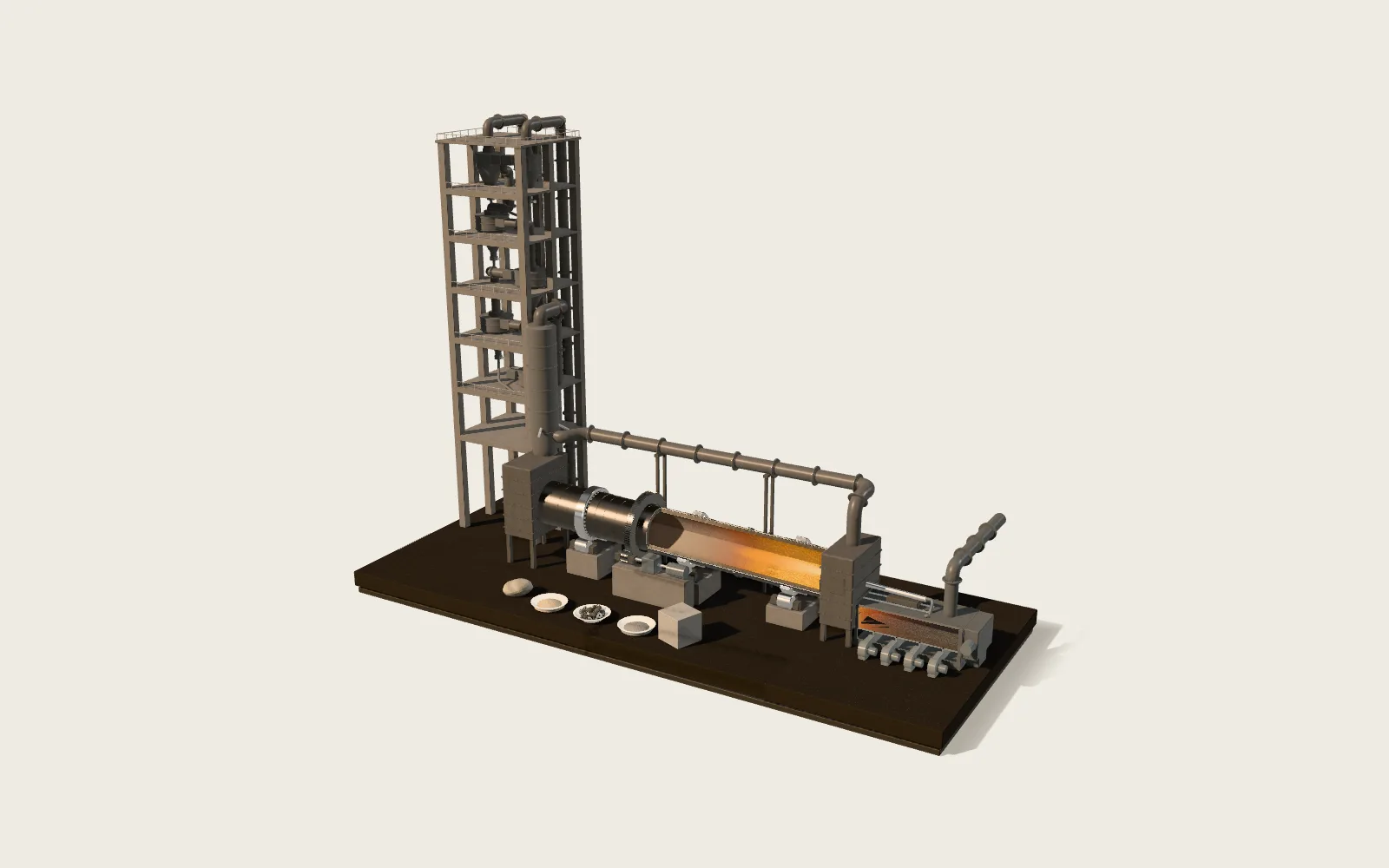
The blowing-out tower comes apart into its roof and duct, the distributor, the wood packing and the brick shell; beside it are the riser with the chlorine, the absorber with its fans, and the steaming-out column with the separator that holds the liquid bromine.
Point at a piece and it is lifted alone and named; otherwise the pieces part together.
Roof and duct · distributor · wood packing · brick tower · riser with the chlorine · absorber and fans · column and separator
Air, Warmth and Chlorine
This page’s model takes the tower as one ideal equilibrium stage. The stripping factor S is the ratio of air to seawater by volume divided by Henry’s constant, and the share blown out is S / (1 + S); with less chlorine than in theory, only that share of the bromide is oxidised. Henry’s constant is the value for pure water and follows the water’s temperature; a real tower is taller, and loses bromine in other ways.
Readouts: the share of seawater’s bromine blown out, the tonnes of seawater a kilogram of bromine takes, and the grams of bromine in a cubic metre of the air leaving the tower. The curve is the share blown out against the air at the present temperature; the vertical line is where S = 1.
Readouts: share blown out · seawater per kilogram · bromine in the air (one-stage model, computed)
Try thisRaise the air-to-seawater ratio from 100 to 200: what share of the bromine leaves the tower before and after, and how many tonnes of seawater does a kilogram of bromine take?
What the model leaves out
The model shows the principle, after the 1934 description of the Kure Beach plant; it is not a copy of that plant. The blowing-out tower is drawn square at about 1:40; the absorber, fans, column and glass are drawn smaller and closer; the packing’s slats are drawn several times too thick; the real tower had many narrow chambers, here there are three. The steaming-out column, condenser and separator are drawn as a principle, and their materials are not sourced. The water’s streams and the air’s path in the section are schematic; so is the orange-brown bromine vapour in the tower and the duct, drawn denser than real (the air leaving the tower holds only about 0.4–0.8 g of bromine a cubic metre). The lab takes the tower as one ideal stage, uses Henry’s constant for pure water, and leaves out the chlorine blown out with the bromine, incomplete absorption and other losses.
Easily misread
Seawater holds no elemental bromine, only bromide; the red-brown bromine appears once chlorine is added. Chlorine oxidises bromide because it is the stronger oxidiser, not because the two swap places at random. The sulfur dioxide step is not waste: it reduces the bromine to bromide in a far smaller volume of liquor, from which chlorine frees it again. The acid is there to stop the bromine hydrolysing. Kure Beach was not the first to get bromine from the sea: Balard got it from salt-works liquor in 1826, and US bromine was already made from the bitterns of evaporated seawater; it was the first plant to work seawater itself at commercial scale. Most bromine today comes from the Dead Sea and from underground brines. Bromine is toxic and corrosive; this page offers no experiment to try at home.
Common questions · 5
- What form does bromine take in seawater?
The bromine in seawater is not red-brown elemental bromine but the invisible bromide ion, Br⁻. Free bromine does not occur in nature; it is found only as bromide (HSDB).
01Bromine in a Kilogram of Sea ↑- Why is seawater acidified before bromine is extracted?
Chlorinated at pH 7.2 without acid, at most 39 % of the bromine can be freed, and up to 10 equivalents of chlorine are spent per mole of bromine (Dow patent US 1,917,762).
02Acid First, to pH 3.5 ↑- Why can chlorine turn bromide into bromine?
Chlorine can oxidise bromide because it is the stronger oxidiser: its standard potential is +1.358 V, bromine’s +1.087 V (CRC). The 0.27 V between them gives an equilibrium constant of about 10⁹ (computed here), so the reaction runs almost to completion.
03Chlorine Takes the Electrons ↑- Is bromine dangerous?
Bromine is toxic and corrosive: breathing it can kill, and it burns skin and eyes severely (ICSC).
08A Dark Red-Brown Liquid ↑- How much seawater does a kilogram of bromine take?
A kilogram of seawater holds about 67 mg of bromine. Even taken out to the last trace, a kilogram of bromine needs about 14.9 tonnes of seawater (computed here).
09How Much Sea for a Kilogram ↑
Sources
- IOC, SCOR and IAPSO (2010): the TEOS-10 manual, Table D.3, the reference composition of seawater (after Millero et al. 2008)
- L. C. Stewart (1934): Commercial Extraction of Bromine from Sea Water, Industrial and Engineering Chemistry 26(4) (pH 3.5, hydrolysis, the towers, the Kure Beach plant)
- Dow patent US 1,917,762 (1933): extracting bromine from dilute saline solutions (39 % at most without acid, the chlorine used)
- Dow patent US 2,143,223 (1939): absorbing in sulfur dioxide, the bromine in the air, condensing and separating
- H. H. Dow, patent US 460,370 (1891): blowing out with air
- Octel Kuhlmann, patent IL 45461 (1977): the absorbing reaction and the liquor’s make-up
- Patent US 8,815,050 (2014): the usual drying of liquid bromine over strong sulfuric acid
- PubChem: Bromine (the HSDB record, quoting Ullmann’s, Kirk-Othmer and the Merck Index: 15 % excess chlorine, air or steam, properties)
- International Chemical Safety Card ICSC 0107: Bromine
- International Chemical Safety Card ICSC 0126: Chlorine
- NIOSH Pocket Guide to Chemical Hazards: Bromine
- R. Sander (2023): Compilation of Henry’s law constants, Br₂
- Standard reduction potentials (from the CRC Handbook, 84th edition)
- A.-J. Balard (1826): Mémoire sur une Substance particulière contenue dans l’eau de la mer
- Royal Society of Chemistry: Periodic Table, Bromine (the name)
- North Carolina Highway Historical Marker D-98: Bromine Extraction
- U.S. Geological Survey (2026): Mineral Commodity Summaries, Bromine
- U.S. Geological Survey (2023): 2019 Minerals Yearbook, Bromine (the world’s main plants and their raw materials, uses)
- Matveev et al. (2001): Bromine oxide–ozone interaction over the Dead Sea (the Dead Sea’s bromide)
- A. M. El-Hamouz and R. Mann (2007): a chemical reaction engineering analysis of the blow-out process (abstract, a typical recovery)
Data
Seawater’s composition is the reference composition of TEOS-10 (IOC, SCOR and IAPSO, 2010, Table D.3, after Millero et al. 2008); its density is from the TEOS-10 Gibbs SeaWater library. Bromine’s Henry’s-law constant is from R. Sander’s compilation (2023); standard potentials from the CRC Handbook (84th edition); properties and safety from the ILO/WHO International Chemical Safety Cards, NIOSH and PubChem’s HSDB. The process and the plant at Kure Beach are from L. C. Stewart (Dow), Industrial and Engineering Chemistry 26 (1934), Dow’s patents US 1,917,762 and US 2,143,223, H. H. Dow’s US 460,370, Octel Kuhlmann’s IL 45461, A.-J. Balard (1826) and the North Carolina highway marker D-98; today’s production and uses from the USGS (2026, 2019); the Dead Sea from Matveev et al. (2001). The towers, the absorber, the column and the glass are a model of the principle after the 1934 description, not any one plant. Material presets, parts and the softbox studio of the site’s model kit are ported from AirsupHQ/machine-skill (MIT, © 2026 Air Supply Technologies Inc.).
The text, pictures and models on this page are licensed CC BY-NC 4.0: free to use and adapt for teaching and other non-commercial purposes, with credit to world.lapla.si. Third-party material listed above keeps its own licence.
Cite this plate
Laplace’s Mini World, Plate 73, “Bromine from Seawater”, https://world.lapla.si/en/bromine/, CC BY-NC 4.0, updated 2026-10-31.
Follow the question
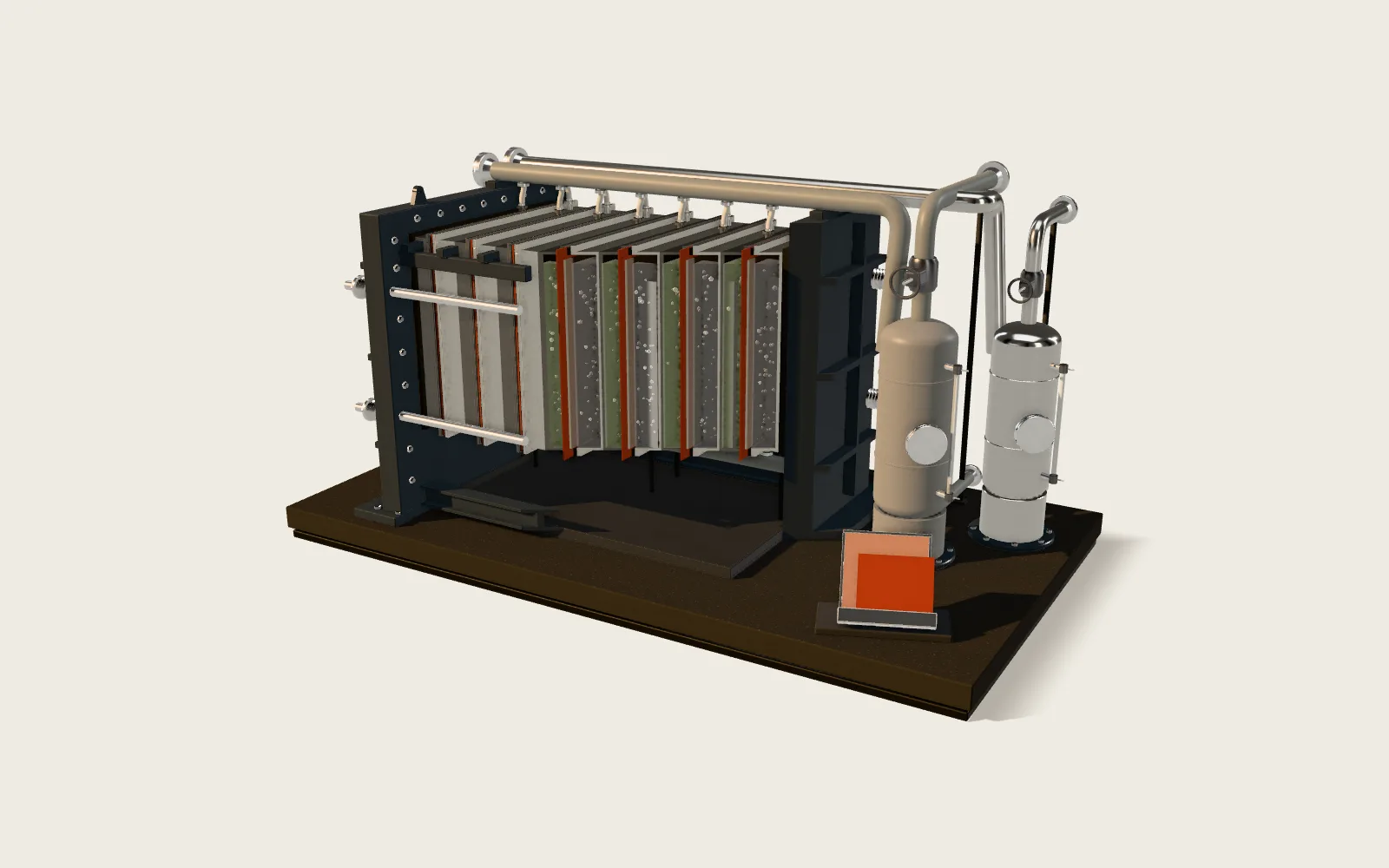 Plate 59Electrolysis of BrinePass a direct current through strong brine and chlorine comes off at the anode, hydrogen at the cathode, and sodium hydroxide (caustic soda) is left behind. In a membrane cell a perfluorinated ion-exchange membrane keeps the two sides apart: it lets sodium ions through and holds back hydroxide and chloride, so the chlorine and the caustic never meet. Each tonne of chlorine takes about 756 kAh of charge and comes with about 1.13 t of caustic soda and 28 kg of hydrogen. In 2010 Europe’s chlor-alkali plants used about 1 % of the region’s electricity.
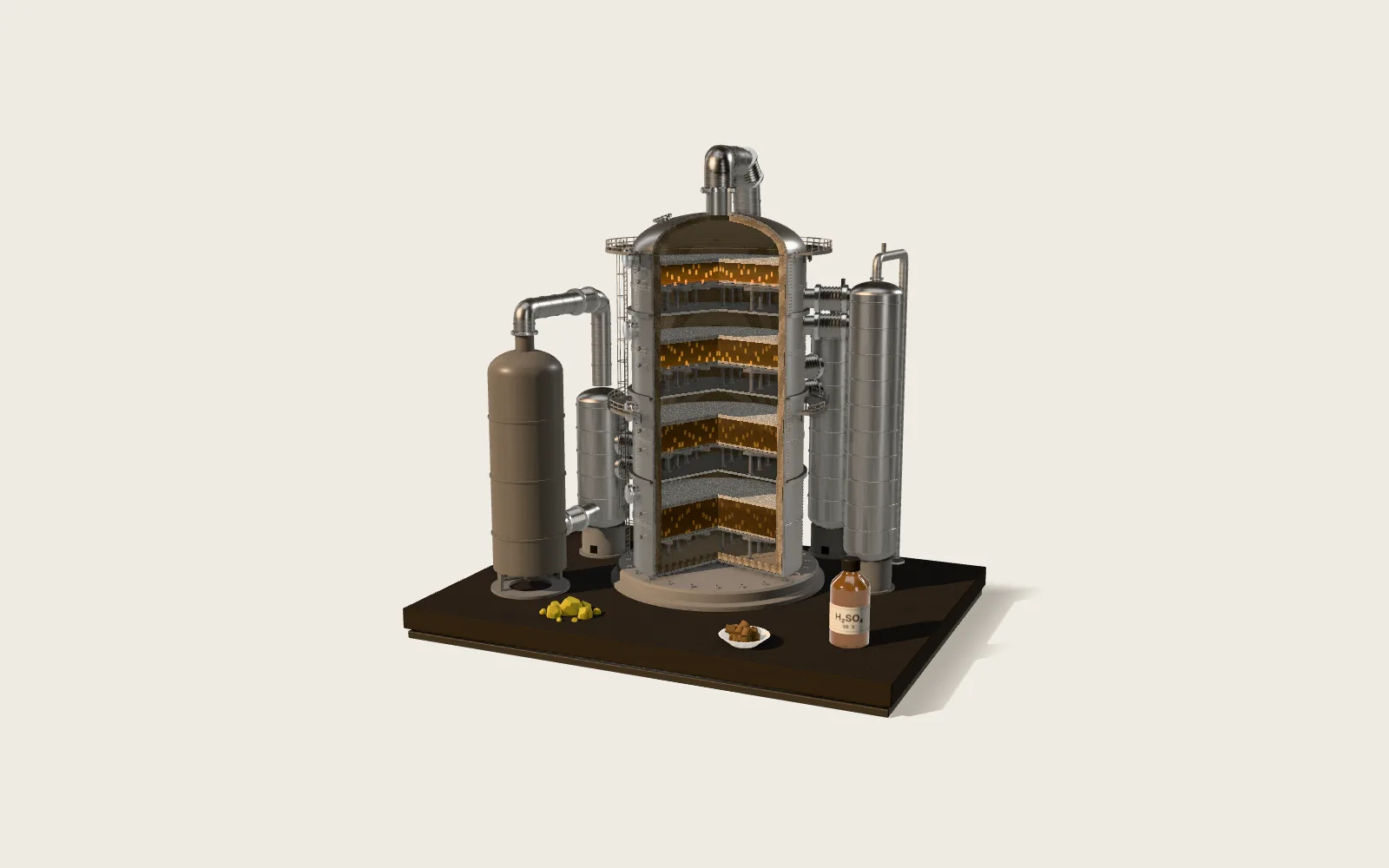 Plate 68Sulfuric Acid from SulfurThe contact process has three steps: burn sulfur to sulfur dioxide, add one more oxygen on a vanadium catalyst to make sulfur trioxide, and absorb the trioxide in strong sulfuric acid. The middle step gives off heat, and the heat pushes the equilibrium back, so the catalyst sits in four beds with the gas cooled between them. Absorbing once after the third bed and converting again lifts the total to 99.7–99.9 %. Most sulfuric acid goes into phosphate fertiliser.