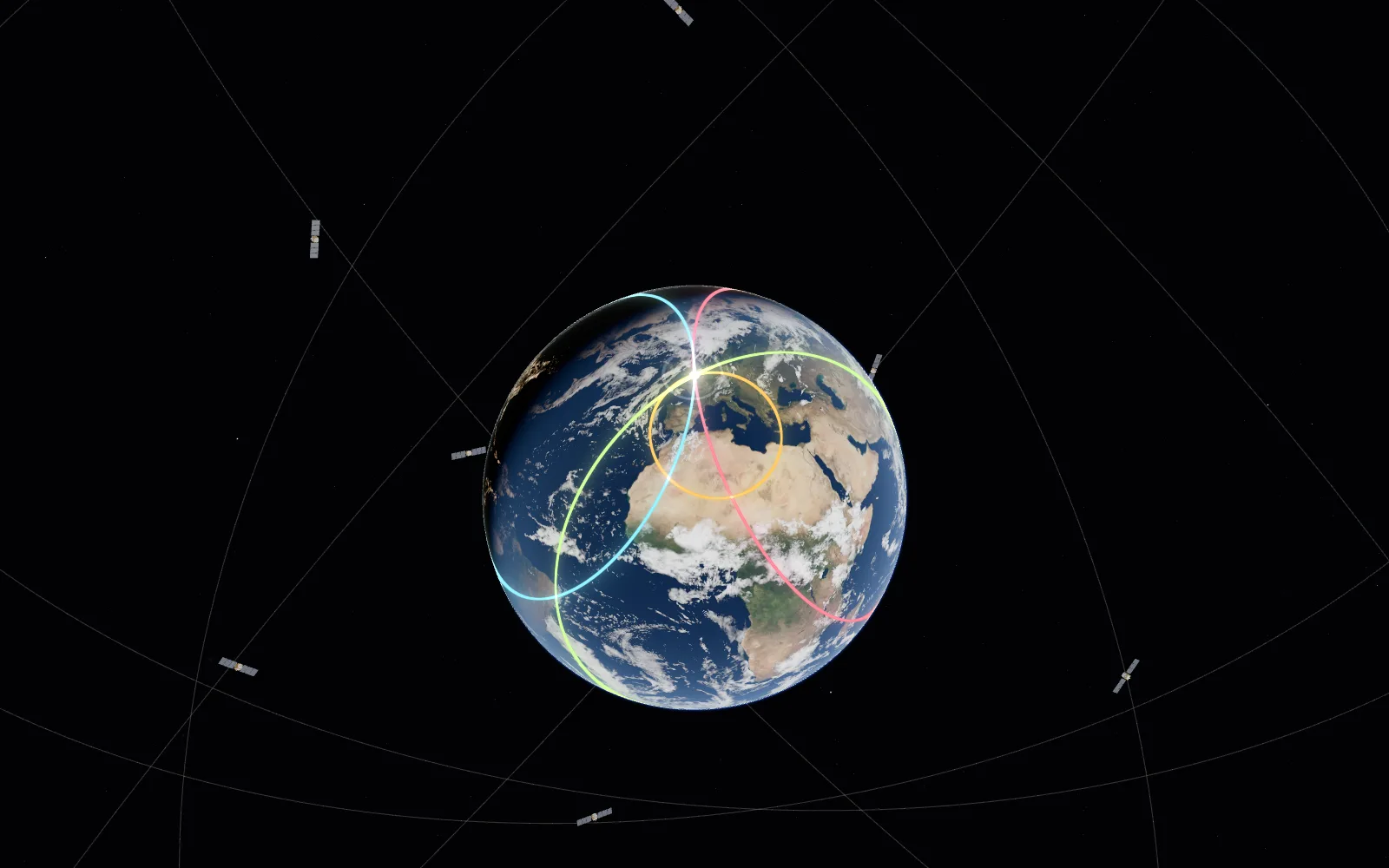
Trapped-Ion Quantum Computers
A line of ions floats 70 µm above gold electrodes, each ion a qubit. On the best machine, two-qubit gates now fail less than once in a thousand.
Chapters · 16
- 01Under One in a Thousand
- 02One Ion, One Qubit
- 03No Field Holds Still
- 04Flattened onto a Chip
- 05Bright or Dark
- 06In a Row
- 07Swaying Together
- 08Linked Through Motion
- 09Cut Open: Steel Around Gold
- 10Gold Electrodes
- 11Light Through the Windows
- 12Ions on the Move
- 13Today’s Machines
- 14Slow, but Precise
- 15Taken Apart
- 16The Bench
Scroll
Under One in a Thousand
The hardest step for a quantum computer is the two-qubit gate, where two qubits act on each other. In November 2025 Quantinuum described Helios, a 98-qubit trapped-ion machine: averaged over all its gate zones, its two-qubit gates err 7.9 × 10⁻⁴ of the time, about 99.92 % right; its single-qubit gates 2.5 × 10⁻⁵. Both are averages measured by randomized benchmarking.
Few errors per gate is not an error-free computation: errors add up. At 99.92 %, a run of 1,000 two-qubit gates comes out all right only about 45 % of the time. The previous machine, H2, reached 99.84 % with 56 qubits; “three nines” for two-qubit gates came first in 2024 on the older H1-1, at 99.914 %.
Helios: 98 qubits · two-qubit 7.9 × 10⁻⁴ · single-qubit 2.5 × 10⁻⁵ · preparation and measurement 4.8 × 10⁻⁴
One Ion, One Qubit
An ytterbium atom that loses one electron becomes the ion ¹⁷¹Yb⁺, with one positive charge. Its lowest level is split in two, 12.6 GHz apart: the lower is 0, the upper 1, and the pair is the qubit. The gap between them barely moves when the magnetic field does, the kind of levels atomic clocks use. What a qubit is: see the superconducting qubit plate.
Every ion of a kind is identical, so none has to be tuned on its own. One ion under special protection kept its phase for about 1.5 hours (5,487 s); inside a machine that is running circuits, about 2 s with a spin echo. Helios uses another ion for its qubits, ¹³⁷Ba⁺, with its two levels about 8.04 GHz apart.
¹⁷¹Yb⁺ · 0 and 1 12.64 GHz apart · one ion about 1.5 h (specially protected) · about 2 s in a machine
No Field Holds Still
With fields that do not change, there is no point that pushes a positive charge back from every side: where it pushes back one way it pushes out another, like a saddle, a valley along one line and a ridge along the other.
The way out is to keep flipping the saddle. The electrodes carry an RF voltage, about 200 V at 42 million cycles a second on H2. The ion is too heavy to follow, and on average it is pushed back to where the field is zero, as into the bottom of a bowl. What is left, a small shake at the RF, is called micromotion. This is the Paul trap; half of the 1989 Nobel Prize in Physics went to Paul and Dehmelt for the ion-trap technique.
H2: about 200 V at 42 MHz · where the RF field is zero · the 1989 Nobel Prize in Physics
Flattened onto a Chip
An early linear ion trap is four parallel rods with the ions on the axis between them. A surface trap lays every electrode flat on a chip: two RF rails either side of a centre electrode, the line where the RF field vanishes above the chip, and the ions held on it. In 2006 the first surface trap held magnesium ions about 40 µm above gold electrodes.
In Quantinuum’s H1 and H2 the ions are 70 µm from the chip’s surface; H2’s chip has 376 electrodes. The figure is a section this page computes for the same height: two RF rails 82.5 µm wide and 80 µm apart put the zero at 70 µm, and 200 V at 42 MHz give a radial trap frequency of about 2.7 MHz, close to the 2.8 and 2.7 MHz H1 reports.
H1, H2: 70 µm from the surface · H2: 376 electrodes · the first surface trap, 2006: about 40 µm
Bright or Dark
The ions are cooled first. Laser light at 369.5 nm pushes against their motion and slows it (how, see the Bose–Einstein condensate plate); finer methods then bring the motion close to its lowest state.
To read out, the same light is tuned to be in tune with 1 only: an ion in 1 scatters photon after photon and shows as a bright spot on the camera; an ion in 0 scatters almost none and stays dark. Only about 3 % of the light is collected. In 2007 one ytterbium ion was read right 97.9 % of the time in 1 ms; on Helios preparation plus measurement errs 4.8 × 10⁻⁴ on average.
369.5 nm · bright = 1, dark = 0 · about 3 % of the light collected · Helios: preparation and measurement 4.8 × 10⁻⁴
In a Row
Put several ions in one trap: the trap pulls them to the middle, their like charges push them apart, and where the two balance they sit in a line. How far apart depends on how tight the trap is, not on the ions’ mass.
Computed here from the formula: ¹⁷¹Yb⁺ ions at an axial frequency of 1 MHz sit 3.45 µm apart as a pair. The drawing shows eight at 0.5 MHz, 21.5 µm end to end, crowded in the middle and looser at the ends, the closest pair 2.77 µm apart. H1’s paper gives four ions 8 µm long at 0.97 MHz; the same calculation gives 8.04 µm.
computed: 0.5 MHz, eight ions · 21.5 µm long · spaced 2.77–3.54 µm · two ions at 1 MHz: 3.45 µm
Swaying Together
Push one ion and the whole line moves: the Coulomb force ties them together. The line has a few shared ways of moving, each at its own frequency. The lowest is the whole line swinging as one, at the trap frequency; the next has the ends moving against each other with the middle still, at √3 times the trap frequency.
In 1995 Cirac and Zoller proposed the shared motion as a bus: write one ion’s state into the motion, then let the motion act on another ion. The same year NIST made a controlled-NOT between one beryllium ion’s internal state and its motion; in 2003 Innsbruck made the Cirac–Zoller gate between two ions.
computed: eight ions · eight axial modes · lowest: the trap frequency · next: √3 times · the drawn sway is greatly enlarged
Linked Through Motion
In 1999 Mølmer and Sørensen proposed another gate: two colours of light on two ions at once, tuned a little off the motion’s sidebands. The motion is driven round a loop in phase space and back to where it began; at the end the motion is as it was and the two ions are entangled. The ions need not be cooled to their lowest state of motion. Quantinuum’s machines use a gate of this kind.
Because the whole line shares its motion, any two ions in it can be linked directly, not only neighbours as on a chip laid out in a grid. In one comparison in 2017, the same algorithm came out right 77.1 % of the time on five fully connected ions and 35.1 % on a superconducting chip linked only to neighbours.
the motion loops back · the two ions entangled · any pair can be linked · 77.1 % against 35.1 % (one comparison, 2017)
Cut Open: Steel Around Gold
This is a room-temperature surface-trap experiment on an optical table: a stainless spherical octagon with eight 2.75-inch windows on its sides and 6-inch flanges top and bottom. Its front top quarter is cut away, the cut faces painted red, to show the chip inside. A person 1.75 m tall stands behind the table.
The chamber is pumped to ultra-high vacuum, at room temperature typically about 10⁻¹¹ Torr; otherwise stray gas molecules hit the ions and scramble the line. The ion pump keeps pumping. Quantinuum’s machines cool their traps far down, H1 to 12.6 K; the model is not any company’s machine.
about 10⁻¹¹ Torr at room temperature · 2.75-inch and 6-inch flanges · a person 1.75 m tall
Gold Electrodes
The chip sits in the well of a white ceramic carrier; fine gold wires, each about 25 µm thick, join the pads round the well to the electrodes at the chip’s edges. The carrier sits in a socket on a post from the bottom flange. H2’s chip package has 280 pins.
The chip’s face is gold electrodes with narrow gaps between them: the long strips carry the RF, the segments either side the DC voltages that push the ions back and forth. The chip drawn here is 10 mm long; H2’s trap is 6.58 mm along its long axis. The slanted tube below is the oven: heated, it sends out ytterbium atoms, and two lasers (398.9 and 369.5 nm) turn them into ions.
a ceramic carrier · gold wires about 25 µm · H2: 280 pins, trap 6.58 mm long · the oven and two ionizing beams
Light Through the Windows
The lasers leave fibre collimators, pass a side window, cross the ions just above the chip and leave by the far window into a beam dump. For ytterbium: 369.5 nm cools and reads out, 935.2 nm brings back ions that fall into another level, 398.9 nm helps to ionize the atoms.
The gates use two more beams crossing at the ions: their frequencies differ by the qubit’s splitting, and their directions differ along the line of ions; some machines use a pulsed 355 nm laser. Ultraviolet light cannot be seen, so the drawn colours stand in. Helios uses barium, so every wavelength changes: 493 and 650 nm to cool, 515 nm for the gates.
369.5 nm: cooling, readout · 935.2 nm: repump · 398.9 nm: ionizing · gates: two crossing beams
Ions on the Move
The longer a line of ions, the more crowded its modes, and the harder it is to touch just two. A 2002 proposal took another way: memory zones and interaction zones on one chip, with the electrodes’ voltages moving ions a few at a time between them, splitting, merging and swapping them. In 2021 the first such machine used up to six qubits.
H2’s trap is shaped like a race track, its gate zones 750 µm apart. Moving is slow: one split or merge takes about 128 µs, and transport takes about 60 % of a circuit’s time. Moved ions warm up, so each pair of qubit ions travels with barium ions that cool them again.
the 2002 proposal · 2021: up to six qubits · gate zones 750 µm apart · transport about 60 % of the time
Today’s Machines
Quantinuum’s H2 started in 2023 with 32 qubits and grew to 56 in 2024; Helios, in 2025, has 98, stored on a ring that turns and fed through a junction into the zones where gates are done. IonQ’s Forte has 36 qubits by the company’s specification.
The 56-qubit H2 ran random circuit sampling at a scale its paper says “appears to be beyond” the best classical algorithms; the Helios paper also says it is far beyond classical simulation. Random circuit sampling is a test, not yet a useful problem on which a classical computer has been beaten.
H2: 32 → 56 qubits · Helios: 98 qubits · Forte: 36 qubits (company figure) · random circuit sampling is a test
Slow, but Precise
Ion gates are slow: a two-qubit gate takes 25 µs on H1, about 70 µs on Helios, 250 µs on a five-ion machine of 2017; on superconducting chips it takes a few hundred nanoseconds. That makes ions tens to a thousand times slower per gate. Helios takes about 55 ms per layer of gates, most of it spent moving and cooling ions.
Their strength is precision, and every qubit reaching every other. To grow, moving and cooling must get faster, or machines must be linked: in 2025 Oxford joined two modules about 2 m apart with light and sent a gate between them at 86 % fidelity.
two-qubit gates: 25–250 µs (ions) · 250–450 ns (superconducting, 2017) · tens to a thousand times slower · Helios: about 55 ms a layer
Taken Apart
The vacuum chamber, the top window, the objective and camera, the trap chip, the ion pump, the helical resonator, the DC feedthroughs and the fibre collimators, one by one.
Rest the pointer on one (tap it on a phone): it lifts on its own and is named, and the rest fade.
The Bench
Set the trap frequency and the number of ions, and the line takes its computed places: the looser the trap, the wider the spacing, always more crowded in the middle.
Then give the first ion a pulse and measure: a pulse of area π flips it from 0 to 1 and it lights up on the camera; π/2 gives it an even chance. Each press of “Measure again” is a new shot. This is the page’s model.
Try thisIn the lab, lower the trap frequency from 1.0 MHz to 0.5 MHz: how far apart are the two closest ions? Then set the pulse to π/2 and measure a few times: about what share of the shots shows ion 1 bright?
What the model leaves out
The instrument on the table looks like a room-temperature surface-trap experiment: the spherical octagon and the ConFlat flanges have their real sizes; the chip, carrier, socket, oven, collimators, resonator and voltage source are drawn the right size for the job, not copied from any company’s machine. Quantinuum’s and IonQ’s machines are cryogenic and their insides are not published in this detail. The chip’s electrode pattern is a sketch, and only a few dozen bond wires are drawn. The magnified layer is enlarged about 6,000 times; the ions’ positions and height are to scale (in the cover’s magnifier the 70 µm between ions and electrodes is drawn shortened, with a break marked), and the glow round each ion stands for the light it scatters, far larger than the ion. The beams’ colours stand in: 355 and 369.5 nm are ultraviolet and cannot be seen. The bench is this page’s model, and leaves out readout errors.
Common misreadings
99.9 % is the average fidelity of one gate, not the chance a whole computation comes out right: with many gates the errors add up. H2’s two-qubit gates are at 99.84 % (with 56 qubits); “three nines” came first on H1-1; Helios is at 99.92 %. Ions are not held by fields that stand still but by a flipping RF field. An ion qubit does not keep its phase for ever: about 1.5 hours for one specially protected ion, about 2 s in a machine. Random circuit sampling beyond classical simulation is not the same as beating classical computers on a useful problem. Ion gates are slow, but precise, and any two qubits can be linked directly.
Common questions · 5
- If each gate is 99.92 % right, what about a whole computation?
Few errors per gate is not an error-free computation: errors add up. At 99.92 %, a run of 1,000 two-qubit gates comes out all right only about 45 % of the time.
01Under One in a Thousand ↑- Why does an ion trap need an RF voltage?
The way out is to keep flipping the saddle. The electrodes carry an RF voltage, about 200 V at 42 million cycles a second on H2. The ion is too heavy to follow, and on average it is pushed back to where the field is zero, as into the bottom of a bowl.
03No Field Holds Still ↑- How far above the chip are the ions in a surface trap?
In Quantinuum’s H1 and H2 the ions are 70 µm from the chip’s surface; H2’s chip has 376 electrodes.
04Flattened onto a Chip ↑- How is a trapped-ion qubit read out?
To read out, the same light is tuned to be in tune with 1 only: an ion in 1 scatters photon after photon and shows as a bright spot on the camera; an ion in 0 scatters almost none and stays dark. Only about 3 % of the light is collected.
05Bright or Dark ↑- How much slower are ion gates than superconducting ones?
Ion gates are slow: a two-qubit gate takes 25 µs on H1, about 70 µs on Helios, 250 µs on a five-ion machine of 2017; on superconducting chips it takes a few hundred nanoseconds. That makes ions tens to a thousand times slower per gate.
14Slow, but Precise ↑
Sources
- Quantinuum (2025): Helios: A 98-qubit trapped-ion quantum computer, arXiv:2511.05465 (98 qubits; ¹³⁷Ba⁺ qubits, ¹⁷¹Yb⁺ coolant; averaged over all zones: single-qubit 2.5 × 10⁻⁵, two-qubit 7.9 × 10⁻⁴, preparation and measurement 4.8 × 10⁻⁴; a two-qubit gate about 70 µs; about 55 ms per layer; random circuit sampling)
- Moses et al. (2023): A Race-Track Trapped-Ion Quantum Processor, PRX 13, 041052 (H2: 32 qubits; about 200 V at 42 MHz; 70 µm from the surface; 376 electrodes; gate zones 750 µm apart; two-qubit 1.84 × 10⁻³, randomized benchmarking averaged over four gate zones; transport about 60 % of circuit time)
- DeCross et al. (2025): The computational power of random quantum circuits in arbitrary geometries, PRX 15, 021052 (H2 at 56 qubits; two-qubit 99.843 %; random circuit sampling at a scale that “appears to be beyond” state-of-the-art classical algorithms)
- Pino et al. (2021): Demonstration of the trapped-ion quantum CCD computer architecture, Nature 592, 209 (up to 6 qubits; 190 V at 42.35 MHz; 70 µm from the surface; 12.6 K; trap frequencies 0.97, 2.8 and 2.7 MHz; four ions 8 µm long; a two-qubit gate 25 µs; a split or merge 128 µs)
- Kielpinski, Monroe and Wineland (2002): Architecture for a large-scale ion-trap quantum computer, Nature 417, 709 (ions moved between memory and interaction zones)
- Cirac and Zoller (1995): Quantum Computations with Cold Trapped Ions, PRL 74, 4091 (cold ions in a linear trap and laser beams)
- Mølmer and Sørensen (1999): Multiparticle Entanglement of Hot Trapped Ions, PRL 82, 1835 (the shared motion need not be fully controlled; the ions may be in thermal motion)
- Monroe et al. (1995): Demonstration of a Fundamental Quantum Logic Gate, PRL 75, 4714 (a controlled-NOT between one ion’s internal state and its motion)
- Schmidt-Kaler et al. (2003): Realization of the Cirac–Zoller controlled-NOT quantum gate, Nature 422, 408
- James (1998): Quantum dynamics of cold trapped ions with application to quantum computation, Appl. Phys. B 66, 181 (the length scale ℓ; the equations of the equilibrium positions; minimum spacing about 2.018 ℓ ÷ N^0.559)
- Olmschenk et al. (2007): Manipulation and detection of a trapped Yb⁺ hyperfine qubit, PRA 76, 052314 (two levels 12.6 GHz apart; 369.53 nm; bright and dark; 97.9 % read right in 1 ms)
- Wang et al. (2021): Single ion qubit with estimated coherence time exceeding one hour, Nat. Commun. 12, 233 (5,487 ± 668 s; dynamical decoupling and continuous sympathetic cooling)
- Chiaverini et al. (2005): Surface-Electrode Architecture for Ion-Trap Quantum Information Processing, arXiv:quant-ph/0501147 (all electrodes in one plane)
- Seidelin et al. (2006): Microfabricated Surface-Electrode Ion Trap for Scalable Quantum Information Processing, PRL 96, 253003 (the first ions held in a surface trap; ²⁴Mg⁺, about 40 µm above gold electrodes)
- Linke et al. (2017): Experimental comparison of two quantum computing architectures, PNAS 114, 3305 (a gate between any pair in a chain; 77.1 % against 35.1 %; ion gates 20 and 250 µs, superconducting 130 and 250–450 ns)
- Bruzewicz et al. (2019): Trapped-ion quantum computing: Progress and challenges, Appl. Phys. Rev. 6, 021314 (an RF trap is anti-confining in at least one direction at every instant, and confines through its time variation and the ion’s inertia; 10–1,000 V at 10–100 MHz; about 2–4 % of the light collected)
- Pagano et al. (2019): Cryogenic trapped-ion system for large scale quantum simulation, Quantum Sci. Technol. 4, 014004 (room-temperature ultra-high vacuum typically about 10⁻¹¹ Torr)
- Main et al. (2025): Distributed quantum computing across an optical network link, Nature 638, 383 (two modules about 2 m apart, a controlled-phase gate teleported over a photonic link, 86 %)
- Maunz (2016): High Optical Access Trap 2.0, Sandia SAND2016-0796R (ion height 68 µm; 25 µm gold wire bonds)
- Quantinuum (2024): blog, two-qubit gates at 99.914 % on H1-1 (the company’s release)
- IonQ: the Forte product page (36 qubits; the company’s specification)
- NobelPrize.org: the 1989 Nobel Prize in Physics (Paul and Dehmelt, the ion-trap technique)
Data
The instrument is a room-temperature surface-trap experiment as such labs describe them (a stainless spherical octagon on ConFlat flanges, a gold surface-electrode chip in a ceramic pin-grid-array carrier, a re-entrant top window for the imaging objective, an ion pump, a helical resonator for the RF, fibre-delivered lasers), not any company’s machine; the commercial machines quoted are cryogenic and their insides are not published in this detail. The ion line, its modes, the trap’s RF null and pseudopotential, the gate’s loop and the laboratory are computed by this page (src/topics/iontrap/science.js, figure.js, tests/iontrap.test.js) from the formulas quoted in its sources (James 1998; the gapless-plane approximation of a surface trap; Mølmer and Sørensen 1999). The magnified layer is drawn to scale except the glow round each ion, which stands for the light it scatters; the laboratory is this page’s model. Material presets, parts and the softbox studio of the site’s model kit are ported from AirsupHQ/machine-skill (MIT, © 2026 Air Supply Technologies Inc.).
The text, pictures and models on this page are licensed CC BY-NC 4.0: free to use and adapt for teaching and other non-commercial purposes, with credit to world.lapla.si. Third-party material listed above keeps its own licence.
Cite this plate
Laplace’s Mini World, Plate F76, “Trapped-Ion Quantum Computers”, https://world.lapla.si/en/iontrap/, CC BY-NC 4.0, updated 2026-11-06.
Follow the question
 Plate F17Superconducting Qubits and Error CorrectionA chip the size of a fingernail holds 97 superconducting circuits. Each one makes mistakes; together they make a “logical qubit” that gets more reliable as it grows.
 Plate F40Quantum Computers of AtomsTweezers of focused laser light each hold a single atom, hundreds to thousands of them in an array; excited to Rydberg states, pairs of atoms run quantum gates.