Soda Ash from Salt
Brine takes up ammonia, then carbon dioxide, and sodium bicarbonate crystallises out; heated, it becomes soda ash. Hou’s process crystallises the ammonium chloride too.
Chapters · 14
- 01The Alkali in Glass
- 02Ammonia First
- 03Thirty-Five Caps
- 04The Least Soluble of Four
- 05Cooled at the Bottom
- 06Heated into Soda Ash
- 07The Ammonia Comes Back
- 08Written Down in a Book
- 09In Sichuan
- 10Cool, Then Add Salt
- 11Joined to an Ammonia Plant
- 12Where the Soda Ash Goes
- 13Section by Section
- 14Temperature, Ammonia, Carbon Dioxide
Scroll
The Alkali in Glass
Soda ash is sodium carbonate, Na₂CO₃. Ordinary glass is 12–16 % sodium oxide, most of it from soda ash; without recycled glass, a tonne of glass takes two to three hundred kilograms of soda ash (computed here from the make-up). The porcelain dish at the front holds soda ash; beside it are lumps of rock salt.
For a long time the alkali came from the ash of burnt seaweed and salt plants, or from natural soda by dried-out lakes. In 1791 Leblanc patented a process: salt treated with sulfuric acid, then the sodium sulfate burnt with limestone and coal. Every 8 tonnes of soda sent about 5.5 tonnes of hydrogen chloride into the air and left about 7 tonnes of waste, mostly calcium sulfide. In 1863 Britain’s Alkali Act required a 95 % cut in the hydrogen chloride.
Electrolysing brine also gives an alkali, but that is caustic soda, sodium hydroxide, on a page of its own. This page is about making sodium carbonate from salt, ammonia and carbon dioxide.
Na₂CO₃ · glass is 12–16 % Na₂O · Leblanc: about 5.5 t of HCl per 8 t of soda
Ammonia First
The step that makes the product in the tower is an exchange: NaCl + NH₄HCO₃ ⇌ NaHCO₃ + NH₄Cl. It can run either way; in the solution there are really four ions, Na⁺, Cl⁻, NH₄⁺ and HCO₃⁻.
The bicarbonate has to come from carbon dioxide, and carbon dioxide dissolves very little in neutral brine. So the brine takes up its ammonia first and meets the carbon dioxide in the tower; Hou’s book of 1942 says the other order cannot work. At 25 °C ammonia’s Henry’s law constant is more than 800 times carbon dioxide’s (NIST’s figures, converted here).
Brine with ammonia in it is alkaline: the carbon dioxide first joins the ammonia as ammonium carbonate, which then turns step by step into ammonium bicarbonate. Mixing saturated brine with as much saturated ammonium bicarbonate solution leaves each only half saturated, and nothing comes out at once; bringing ammonia and carbon dioxide in as gases keeps the brine strong.
NaCl + NH₃ + CO₂ + H₂O → NaHCO₃ + NH₄Cl · ammonia first, then CO₂
Thirty-Five Caps
The carbon dioxide goes in through the carbonating tower. The standard tower in Hou’s book is a stack of cast-iron rings about 2 m across inside: the cooling rings at the bottom about 1 m high each, the rings above about 0.46 m, about 75 feet, some 23 m, from base to top.
Inside are about 35 division plates, each with a hole in the middle covered by a “mushroom” cap. The carbon dioxide is forced in at the bottom at about 2.4 bar gauge (34–36 lb in Hou’s book, converted here); it gathers under each cap and leaves round its rim as bubbles, rising plate by plate. The ammoniated brine comes in at the top and flows down.
In the double-entry arrangement the strong gas back from the calciner, over 90 % carbon dioxide, enters at the bottom and the weaker lime-kiln gas through an entry higher up (Hou, 1942). The blue in the section is the gas, as a schematic. The model’s tower is drawn more than twice as wide as a real one, with fewer, larger cooling tubes.
about 2 m across · about 23 m tall · about 35 plates and caps · about 2.4 bar gauge at the bottom
The Least Soluble of Four
The liquor in the tower holds sodium, ammonium, chloride and bicarbonate together, so four salts could crystallise: NaCl, NH₄Cl, NaHCO₃ and NH₄HCO₃. In pure water sodium bicarbonate is the least soluble, then ammonium bicarbonate; salt and ammonium chloride dissolve far more.
Sodium bicarbonate is not insoluble: at 20 °C, 100 g of water takes 9.6 g. But the liquor is full of sodium ions: at 15 °C, water saturated with salt takes only 10 g per kilogram, about a ninth of what pure water takes (Fedotieff, 1904). As the bicarbonate builds up, sodium bicarbonate passes saturation first and crystallises.
Hou’s book says it comes out heavily once about 40 % of the ammonia has become bicarbonate, and keeps coming to the bottom. In the section the liquor grows whiter towards the foot: those are the crystals. Good ones average 0.1–0.2 mm and feel gritty between the fingers.
NaCl + NH₄HCO₃ ⇌ NaHCO₃ + NH₄Cl · at 20 °C, 9.6 g of NaHCO₃ per 100 g of water
Cooled at the Bottom
Taking up carbon dioxide and crystallising bicarbonate both give off heat. The ammoniated brine goes in at about 30 °C; the hottest place, about two-thirds of the way up, reaches about 60 °C (Hou, 1942).
The lower half of the tower is the cooling section: many cast-iron water tubes run across it, their ends in water boxes outside, and the cooling rings make up about half the height. The liquor is cooled to about 22 °C before it is drawn off at the bottom; the colder it is, the less bicarbonate stays dissolved. Crystals started warm and cooled slowly grow large and filter well.
The tubes slowly crust over with bicarbonate, so the towers take turns at “cleaning”: after about four days making, a tower’s water is cut off, it gets the weak gas and fresh liquor, and the crust dissolves. With five towers in a group, one is cleaning every day.
in at about 30 °C · hottest about 60 °C · about 22 °C at the bottom · cleaned after about 4 days
Heated into Soda Ash
The tower’s own pressure pushes the slurry from its bottom up 35–40 feet, and it flows down into rotary vacuum filters there (Hou, 1942). A drum wrapped in felt turns through it under suction, the bicarbonate stays on the drum, a thin film of water washes the salt out of it, and a knife scrapes it off. What runs through is the mother liquor, carrying the ammonium chloride and the salt not used.
The bicarbonate goes into a calciner and is heated to 160–230 °C (EU BREF): 2 NaHCO₃ → Na₂CO₃ + H₂O + CO₂. 168 g of bicarbonate leave 106 g of soda ash (computed here). Modern plants mostly use steam-heated rotary calciners; the model shows a rotary drum.
The carbon dioxide it gives off is compressed and sent back to the towers. By the equation that is half the carbon dioxide the towers use; Hou’s book puts the carbon dioxide taken from the lime kiln and that coming back from the calciner at about 1.0–1.2 to 1 by weight.
2 NaHCO₃ → Na₂CO₃ + H₂O + CO₂ · 160–230 °C · half the CO₂ goes back
The Ammonia Comes Back
The Belgian Ernest Solvay made this work. He applied for his patent in 1861, his works at Couillet started in 1865, and from 1869 they used the carbonating tower. The reaction was not new: it had been patented in England in 1838, but before him no plant built on it made money.
The mother liquor holds 180–200 g of ammonium chloride per litre (Hou, 1942). Ammonia is dear, so Solvay’s process heats the liquor and adds milk of lime: 2 NH₄Cl + Ca(OH)₂ → CaCl₂ + 2 NH₃ + 2 H₂O, and the ammonia boils off back into the brine. The EU BREF puts the ammonia going round at 500–550 kg per tonne of soda ash, less than 0.5 % of it lost.
The whole account is 2 NaCl + CaCO₃ → Na₂CO₃ + CaCl₂. The chlorine leaves with the calcium: each tonne of soda ash sends out about 10 m³ of waste liquor holding about a tonne of calcium chloride (EU BREF, converted here), most of which can only be disposed of. Nor is the salt used up: a tonne of soda ash takes 1.53–1.8 t of salt, where the equation needs 1.1 t.
2 NH₄Cl + Ca(OH)₂ → CaCl₂ + 2 NH₃ + 2 H₂O · about 1 t of CaCl₂ per tonne · 61–72 % of the sodium used
Written Down in a Book
Hou Debang was born in Fujian in 1890, took his doctorate at Columbia University in 1921 and that year went home to run the technical side of the Yongli soda works that Fan Xudong had set up at Tanggu, near Tianjin. It took Yongli years to get from trial runs to good soda: only in June 1926 could it make good soda ash without a break. Its brand was the Red Triangle.
The ammonia-soda works then kept their know-how secret: they would rather not patent the equipment they built than let outsiders into the plant. In 1933 Hou published Manufacture of Soda in New York, setting out the process’s equipment, operation and data; in its preface he called it an exception to the trade’s long habit of secrecy.
The tower, the temperatures and many of the figures on this page come from its second edition of 1942.
1921 to Yongli · good soda ash without a break from 1926 · Manufacture of Soda, 1933
In Sichuan
During the war Yongli moved to Wutongqiao in Sichuan. The well salt there was dear and impure, the ammonia-soda process turned only about seven tenths of the salt into soda ash, and there was nowhere for the waste liquor to go (Ye Qing, 2009).
Hou tried to buy the licence of Germany’s Zahn process; the talks failed, so the team worked it out themselves. Directing a group in Hong Kong and elsewhere from New York, he had them run more than 500 cycle trials; in half a year they understood the Zahn process and went on to their own. On 15 March 1941 Fan Xudong proposed at a works meeting that it be called Hou’s process.
In November 1943 a continuous pilot started in Sichuan, making a dozen or so kilograms of soda ash and ammonium chloride a day. War kept a plant from being built; in 1961 a unit for 80,000 tonnes a year started trial runs at Dalian. At its national appraisal in 1964 Hou himself proposed the new name, the combined (dual) process.
named Hou’s process 1941 · pilot 1943 · Dalian 1961 · renamed the combined process 1964
Cool, Then Add Salt
Hou’s process does not break up the ammonium chloride with lime; it crystallises it. The mother liquor, its bicarbonate filtered off, first takes up ammonia and is then cooled: ammonium chloride dissolves less in the cold, and some of it comes out. A 2023 patent from a combined-process plant describes cooling it to about 10 °C.
Then salt goes in. As the salt dissolves, its extra chloride ions push the ammonium chloride past saturation and a second crop comes out: the common-ion effect. Fedotieff measured in 1904 that at 0 °C a kilogram of pure water takes 5.57 mol of ammonium chloride, but water also saturated with salt only 2.73 mol.
Ammonia goes in before the cooling to turn the liquor’s bicarbonate into carbonate, so sodium bicarbonate does not come out with the ammonium chloride. The salted liquor takes up ammonia again and goes back to the towers: the salt’s sodium ends up in soda ash, its chlorine in ammonium chloride.
ammonia → cooled (about 10 °C) → salted out · at 0 °C, NH₄Cl from 5.57 down to 2.73 mol per kg of water
Joined to an Ammonia Plant
This way the ammonia leaves as part of a product and must be made up all the time, and the carbon dioxide no longer comes from a lime kiln. The answer is an ammonia plant: it makes ammonia and gives off carbon dioxide, and the soda plant stands beside it. Hou wrote in 1942 that the two industries could stand side by side. How ammonia is made is on the Haber–Bosch page.
A combined plant uses no limestone and leaves no calcium chloride; more than 95 % of the salt is used, against about seven tenths in Solvay’s process. Each tonne of soda ash comes with about a tonne of ammonium chloride, used mainly as a fertiliser for rice; most such plants are in China (EU BREF).
Making soda ash and ammonium chloride together was not one plant’s idea alone: Germany’s Zahn process came earlier; a patent by Georges Claude, filed in 1919, already adds ammonia, cools and then adds salt; the Netherlands and Japan built such plants too. Hou’s process is one worked out in China and later used there at scale.
ammonia and CO₂ from an ammonia plant · over 95 % of the salt used · about 1 t of NH₄Cl per tonne
Where the Soda Ash Goes
The world made about 71 million tonnes of soda ash in 2025, about a quarter from natural deposits and three quarters by chemistry (USGS estimates). China made about 38 million tonnes, the most; the United States about 12 million, all of it from natural soda.
In the United States 45 % of soda ash goes into glass and 28 % into chemicals; the rest into soap and detergents, flue-gas desulfurisation, paper, water treatment and more. In China the combined process holds about half of soda ash capacity (an industry count for 2024: about 48 %).
The jar at the front right holds ammonium chloride, the dish soda ash, and on the left is salt: the plant takes in salt, ammonia and carbon dioxide, and these two come out.
world output about 71 Mt in 2025 · China about 38 Mt · US: 45 % into glass
Section by Section
The tower comes apart into its cooling section, lower and upper sections and head, each still cut open so every plate and cap shows; the bottom ring stays. Beside it are the filter, the calciner and the ammonium chloride crystalliser.
Rest the pointer on a part and it lifts on its own, named; otherwise the sections stand apart together.
head · upper section · lower section · cooling section · filter · calciner · crystalliser
Temperature, Ammonia, Carbon Dioxide
Computed here: each kilogram of water holds 5.2 mol of salt, about the strength of the ammoniated brine in Hou’s book; the ammonia and the carbon dioxide are a lever each. The carbon dioxide first makes ammonium carbonate with the ammonia, then bicarbonate; a salt crystallises once the product of its two ions passes the value it has when saturated in pure water. It is an ideal model that leaves out how the ions act on one another.
At 15 °C the model’s best use of the sodium with no ammonium bicarbonate coming out is 78.3 %; Fedotieff worked out 78.8 % from his measured phase diagram in 1904. In a real tower the bicarbonate comes out heavily once about 40 % of the ammonia is bicarbonate; in the model it takes half: the model leaves out the hydrolysis of ammonium carbonate.
Readouts: the salt that comes out first, the sodium bicarbonate out per kilogram of water, the share of the sodium used. In the chart the carbon dioxide taken up runs across; the two lines are the sodium and ammonium bicarbonate out.
ideal solubility-product model · 5.2 mol NaCl per kg of water · best at 15 °C 78.3 % (Fedotieff: 78.8 %)
Try thisTake the ammonia to 0: does any sodium bicarbonate come out? Then set it back to 5.9 mol and cool the liquor from 20 °C to 0 °C: which other salt now comes out with it?
What the model leaves out
This is a model of the principle: the tower is drawn more than twice as wide as a real one, with fewer, larger rings, caps and cooling tubes; the filter, the calciner and the crystalliser are drawn small and close by, and the filter’s stand lower than real. The making of the ammoniated brine, the lime kiln, the ammonia still, the compressors and the ammonia plant are not shown. The gas in the section is a schematic. The lab is an ideal solubility-product model: no interaction between the ions, no hydrolysis of ammonium carbonate.
Easy to get wrong
Sodium bicarbonate is not insoluble; it is the least soluble of the four salts. In Solvay’s process the ammonia goes round and round; what is used up is salt and limestone. Hou’s process does not skip the ammonia recovery for free: it trades the lime and the calcium chloride for ammonium chloride fertiliser, and the ammonia must be made up from an ammonia plant. Nor was it the first process to make soda ash and ammonium chloride together. This page gives salt use only as “about seven tenths” and “over 95 %”; no authoritative figure more precise was found.
Common questions · 5
- Why does the brine take up ammonia before carbon dioxide?
The bicarbonate has to come from carbon dioxide, and carbon dioxide dissolves very little in neutral brine.
02Ammonia First ↑- Why does sodium bicarbonate come out of the solution?
Sodium bicarbonate is not insoluble: at 20 °C, 100 g of water takes 9.6 g.
04The Least Soluble of Four ↑- How does sodium bicarbonate become soda ash?
The bicarbonate goes into a calciner and is heated to 160–230 °C (EU BREF): 2 NaHCO₃ → Na₂CO₃ + H₂O + CO₂.
06Heated into Soda Ash ↑- What does the Solvay process throw away?
The whole account is 2 NaCl + CaCO₃ → Na₂CO₃ + CaCl₂.
07The Ammonia Comes Back ↑- Why does adding salt bring ammonium chloride out?
As the salt dissolves, its extra chloride ions push the ammonium chloride past saturation and a second crop comes out: the common-ion effect.
10Cool, Then Add Salt ↑
Sources
- Te-Pang Hou (1942): Manufacture of Soda, 2nd ed. (the tower’s build and size, its temperatures, why ammonia goes in first, the solubility tables, filtering and calcining, cleaning the towers, salt used)
- P. P. Fedotieff (1904): Der Ammoniaksodaprozess vom Standpunkte der Phasenlehre, Z. physik. Chem. 49 (the reciprocal salt pair, its three-salt points, the most sodium it can give up)
- A. Seidell (1919): Solubilities of Inorganic and Organic Compounds, 2nd ed. (the four salts’ solubility in water)
- European Commission, Best Available Techniques reference document: Large Volume Inorganic Chemicals – Solids and Others (2007), chapter 2, soda ash (the process, calcining, the ammonia loop, the waste liquor, salt used, ammonium chloride co-produced)
- European Commission, Best Available Techniques reference document for the manufacture of glass (2013) (the sodium oxide in soda-lime glass)
- U.S. Geological Survey (2026): Mineral Commodity Summaries, Soda Ash (output and uses in 2025)
- NIST Chemistry WebBook: Henry’s law constants of carbon dioxide
- NIST Chemistry WebBook: Henry’s law constants of ammonia
- Ye Qing (2009): The combined soda process in China, Engineering Studies 1(4) (the work in Sichuan, the name, the pilot, Dalian, the new name, salt used)
- Zhang Yifan, Wang Lang (2025), Science & Technology Review 43(13) (the combined process’s salt use, after Hou and Hu, Acids and Alkalis)
- I. Fechete (2016): Ernest Gaston Joseph Solvay, Comptes Rendus Chimie 19 (the patent, the works, the tower)
- C. Flavell-While (2011): Nicolas Leblanc – Revolutionary discoveries, The Chemical Engineer (the Leblanc process’s waste, the Alkali Act)
- Chinese Academy of Sciences, Academic Divisions: Hou Debang (life, the Red Triangle brand)
- S. Guo (2008): Hou Te-Pang, Complete Dictionary of Scientific Biography (Yongli, 1926, the book of 1933)
- Wuhuan Engineering (2023): patent application CN116294279A (cooling and salting out in a combined-process plant today)
- G. Claude (filed 1919): US patent 1,491,672 (ammonia first, then cooling out ammonium chloride, then salt)
Data
Solubilities in water are from A. Seidell, Solubilities of Inorganic and Organic Compounds (2nd ed., 1919: Dibbits 1874, Andreae 1884, Mulder); the reciprocal salt pair, its three-salt points and the most sodium a solution can give up from P. P. Fedotieff, Zeitschrift für physikalische Chemie 49 (1904). The lab’s ideal solubility-product model, the mass balances and the unit conversions are computed here. The tower, its temperatures, the filter, the calciner and the plant figures of the 1920s–30s are from Te-Pang Hou, Manufacture of Soda (2nd ed., 1942); modern figures from the EU’s Best Available Techniques reference documents (soda ash, 2007; glass, 2013) and the USGS Mineral Commodity Summaries (2026); Henry’s law constants from the NIST Chemistry WebBook; the combined process’s history from Ye Qing (Engineering Studies, 2009); today’s crystallisation steps from a 2023 Chinese patent (CN116294279A). The tower, the filter, the calciner and the crystalliser are a model of the principle, not any one plant. Material presets, parts and the softbox studio of the site’s model kit are ported from AirsupHQ/machine-skill (MIT, © 2026 Air Supply Technologies Inc.).
The text, pictures and models on this page are licensed CC BY-NC 4.0: free to use and adapt for teaching and other non-commercial purposes, with credit to world.lapla.si. Third-party material listed above keeps its own licence.
Cite this plate
Laplace’s Mini World, Plate 72, “Soda Ash from Salt”, https://world.lapla.si/en/housoda/, CC BY-NC 4.0, updated 2026-10-31.
Follow the question
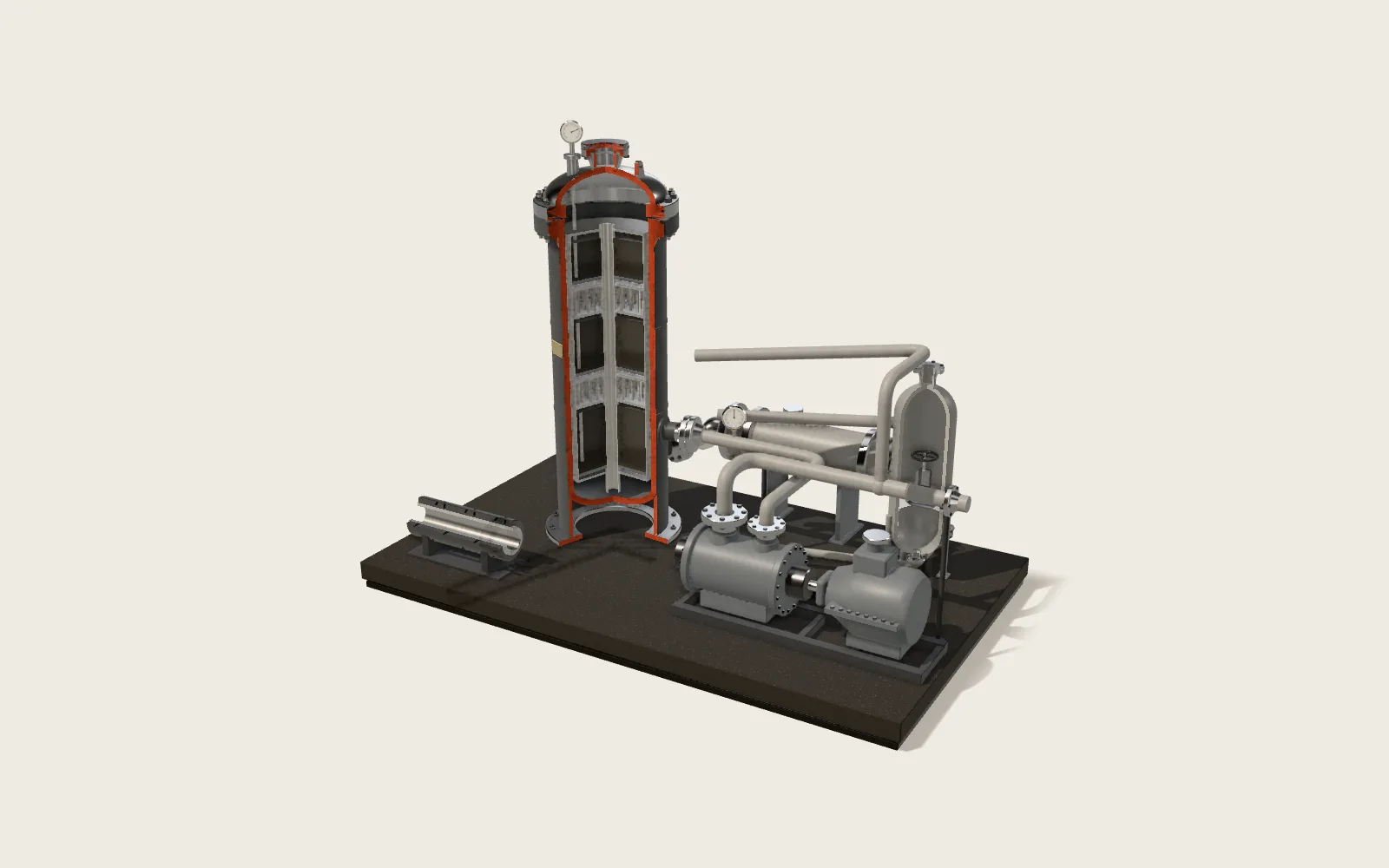 Plate 54Nitrogen from the AirAir is nearly four-fifths nitrogen, yet crops can’t use it: the nitrogen molecule’s triple bond is too strong. The Haber–Bosch process presses nitrogen and hydrogen to 100–250 bar, heats them to 350–550 °C and joins them on an iron catalyst to make ammonia. Cold, the equilibrium favours ammonia but the reaction crawls; hot, it runs fast but yields little, so plants settle on a compromise. Each pass converts only a fifth to a third, and the rest goes round again. About 70 % of the ammonia made today becomes fertiliser.
 Plate 59Electrolysis of BrinePass a direct current through strong brine and chlorine comes off at the anode, hydrogen at the cathode, and sodium hydroxide (caustic soda) is left behind. In a membrane cell a perfluorinated ion-exchange membrane keeps the two sides apart: it lets sodium ions through and holds back hydroxide and chloride, so the chlorine and the caustic never meet. Each tonne of chlorine takes about 756 kAh of charge and comes with about 1.13 t of caustic soda and 28 kg of hydrogen. In 2010 Europe’s chlor-alkali plants used about 1 % of the region’s electricity.