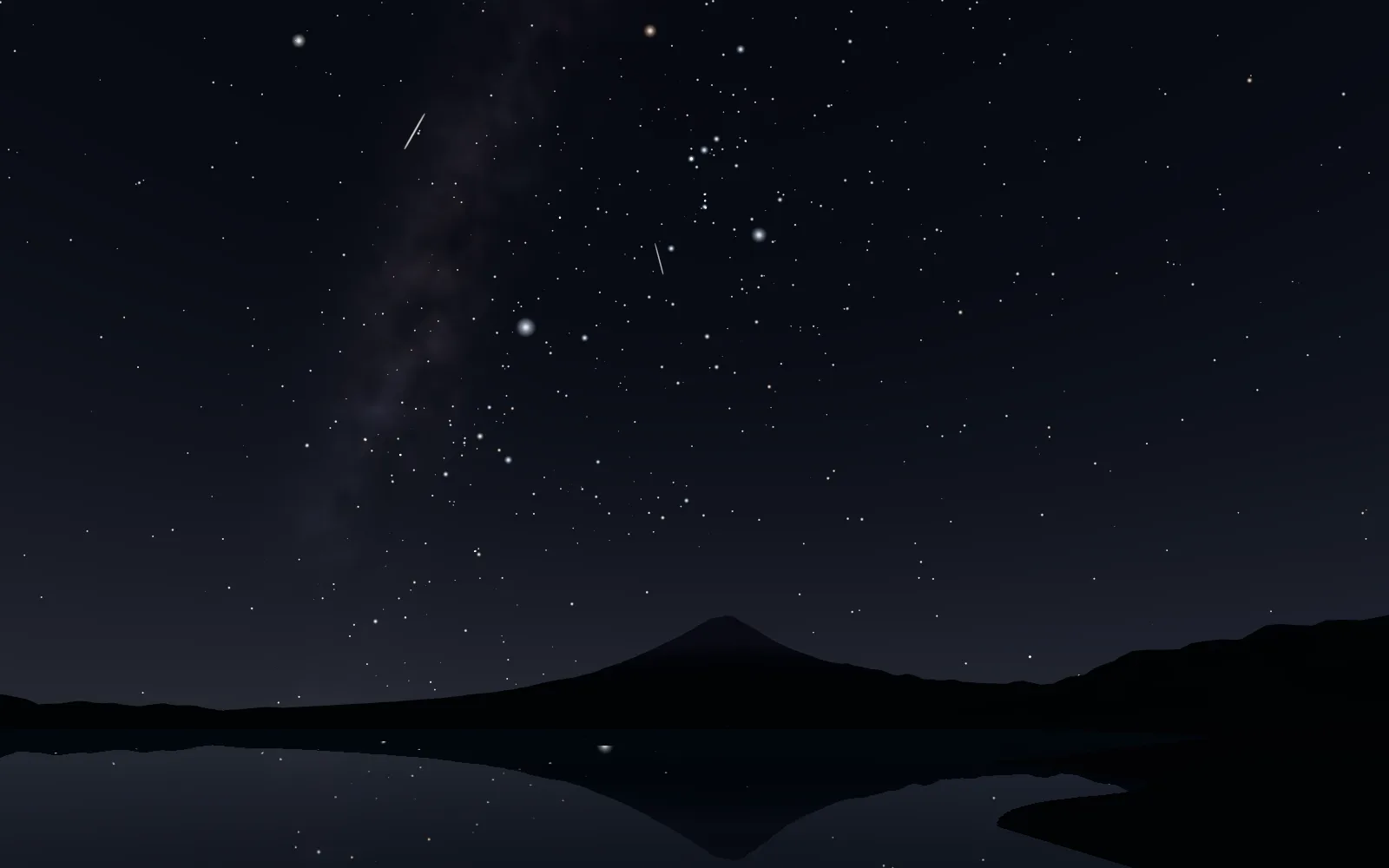
Ice Rings Around the Sun
Cirrostratus is thin enough for the Sun to shine through. Its ice crystals are small hexagonal prisms. Light crossing them is turned through an angle, and it gathers where that turn is smallest: a ring of light 22° from the Sun.
Scroll
A Ring 22° from the Sun
A halo is a ring of light around the Sun (or the Moon), about 22° in radius: roughly the span of an outstretched hand at arm’s length. It forms in cirrostratus, a cloud over six kilometres up, cold enough to be almost all ice, and thin enough to show the Sun’s outline.
In parts of Europe and the United States a halo can be seen on average twice a week, far more often than a rainbow. It sits close to the Sun, and few people look there.
Model: a figure on a snowfield faces the Sun; the glass dome shows the sky as they see it
Every Crystal Is a Prism
Most crystals in cirrostratus are hexagonal prisms: six side faces and two end faces, the small ones a few tens of micrometres across. Light enters one side face and leaves by the next but one. Those two faces, extended, meet at 60°, so to this beam they are a 60° prism.
Entering the ice, the light bends towards the normal; leaving, it bends again. In all, its direction turns through an angle: the deviation.
Taken apart step by step: a beam through one hexagonal prism
Light Crowds at the Smallest Turn
The deviation depends on the angle at which light comes in, but it has a minimum. Ice has an index of about 1.31, and a 60° prism’s minimum deviation is 21.8°. As the turntable turns, the spot on the screen moves inward, stops at 21.8° and goes back.
Near the minimum the deviation changes most slowly: very different angles in give nearly the same direction out. The crystals in a cloud point every which way, and they send the most light to near 21.8° and none at all to smaller angles. So the halo has a sharp inner edge, and the sky inside it is darker.
The spread on the demonstration is six times the real one, to separate the colours; the real one is about 0.6°
Red on the Inside
Ice bends violet a little more than red: its index is about 1.307 at 700 nm and 1.319 at 400 nm. So red has the smallest minimum deviation, about 21.6°, and violet about 22.6°.
The halo’s inner edge is therefore red, then orange and yellow. Further out the colours overlap and add up to a whitish, slightly blue light.
Sundogs: Spots Beside the Sun
Thin plate crystals fall like leaves, their large faces flat. Then every crystal’s side faces are vertical, and light can only be turned sideways. Instead of a full ring there are two bright spots, either side of the Sun and at its height: sundogs, or parhelia.
The higher the Sun, the more steeply light crosses the crystals, the larger their effective index, and the further out the sundogs: 21.9° from the Sun on the horizon, 23.1° at 20°, 27.7° at 40°. Above about 61° the light can no longer get out, and there are none.
More Arcs
In the same flat plates, light can also enter the top face and leave by a side face. Those faces meet at 90°. They paint a coloured arc near the zenith, the circumzenithal arc, red on the side towards the Sun. It appears only with the Sun below about 32°, and is brightest with the Sun near 22°.
Column crystals fall with their long axes level and draw an upturned arc on top of the 22° halo, the upper tangent arc; with the Sun above about 29°, it joins the lower one in an oval around the halo. Vertical crystal faces reflect sunlight like mirrors and draw a white level ring at the Sun’s height, the parhelic circle. Light through a side face and an end face (90°) makes the 46° halo, much fainter and rarer than the 22°.
Why Not Every Cloud
It takes ice crystals, and well-formed ones with flat faces. Most low clouds are water droplets, which are round and make no halo; thick cloud hides the Sun. So halos come mostly in thin, high cirrostratus, and in very cold places in ice crystals near the ground (diamond dust). What a sky shows depends on the crystals’ shapes and how they are held: tumbling crystals give the 22° halo, level plates sundogs and the circumzenithal arc, level columns the tangent arcs.
A halo is not a rainbow. A rainbow comes from raindrops, where light reflects once inside a drop; you stand with your back to the Sun, the bow is centred on the point opposite the Sun, about 42° in radius, red outside. A halo comes from ice, light only refracted, not reflected inside; you face the Sun, the ring is centred on it, red inside.
The Bench
The sun lever raises the Sun from the horizon to 60°. The three kinds of crystal switch on and off separately: tumbling, level plates, level columns. The turntable turns the prism on the demonstration, and the readout gives that beam’s deviation. Each time the Sun moves, the sky in the dome is traced again with about a million rays.
Try thisSwitch on only “Level plates” and raise the Sun from 0° to 40°: how much further out do the sundogs move, and at what height does the circumzenithal arc vanish?
What the model leaves out
The halos in the sky are a Monte Carlo ray trace: each ray takes one wavelength between 400 and 700 nm and the ice index of Warren and Brandt; at every face of a hexagonal prism the Fresnel equations decide between reflection and refraction, and a ray may reflect inside many times. Three kinds of crystal: tumbling (about as long as wide), level thin plates (about an eighth as thick as wide), and long columns with level axes; the two level kinds wobble at random by about 0.7°. There is no diffraction, so none of the blurring very small crystals give. The Sun is a 0.52° disc with a 5778 K black-body spectrum. How much of each kind of crystal there is is set by the page, not observed; the halos are brightened against the sky so they read inside the dome. The sky’s colour and the cirrus are painted. The sky in the dome is worked out for the eyes of the figure at its centre; from outside you see that sky as projected on the glass. The spread of colours on the demonstration is six times the real one.
Easy to get wrong
A halo is not a rainbow: a rainbow is seen with your back to the Sun, in rain; a halo facing the Sun, in ice cloud, and it needs no reflection inside the crystals. 22° is the angle the light is turned, not how far away the crystals are, so everyone’s halo is centred on the Sun in their own eyes. Sundogs are not extra suns, and they do not sit on the 22° halo: the higher the Sun, the further outside it they are. The circumzenithal arc is vivid and often called an upside-down rainbow, but it too is light refracted by ice. Halos are said to foretell rain, and cirrostratus often does run ahead of a warm front, but rain does not always follow. To look at a halo, first hide the Sun behind your hand or a roof; never look straight at the Sun.
Sources
- Warren & Brandt (2008): Optical constants of ice from the ultraviolet to the microwave: a revised compilation, J. Geophys. Res. 113, D14220
- University of Washington: optical constants of ice, data table (2008)
- Tape: Atmospheric Halos (AGU Antarctic Research Series 64, 1994)
- Greenler: Rainbows, Halos, and Glories (Cambridge University Press, 1980)
- Cowley, Atmospheric Optics: common halos
- Cowley, Atmospheric Optics: how the 22° halo forms
- Cowley, Atmospheric Optics: sundogs
- Cowley, Atmospheric Optics: the circumzenithal arc
- Cowley, Atmospheric Optics: tangent arcs
- WMO International Cloud Atlas: cirrostratus
- Wyman, Sloan & Shirley (2013): Simple analytic approximations to the CIE XYZ colour matching functions, JCGT 2
Data
Refractive index of ice: Stephen G. Warren and Richard E. Brandt, Optical constants of ice from the ultraviolet to the microwave: a revised compilation (J. Geophys. Res. 113, D14220, 2008), table from the University of Washington. Halo geometry after Walter Tape, Atmospheric Halos (AGU Antarctic Research Series 64, 1994), Robert Greenler, Rainbows, Halos, and Glories (Cambridge University Press, 1980), and Les Cowley’s Atmospheric Optics. Colour from the CIE 1931 observer in the analytic fit of Chris Wyman, Peter-Pike Sloan and Peter Shirley (JCGT 2, 2013). Cloud definitions from the WMO International Cloud Atlas. The ray tracer, the diorama, the prism demonstration and the words are the site’s own.
Follow the question
 Plate 07Why a Rainbow Is RoundIt does not hang anywhere in the sky. It is a ring of light 42 degrees around the shadow of your own head.
 Plate 08Why Snowflakes Have Six PointsEvery snowflake grows from one tiny six-sided crystal of ice.