Sparse Autoencoders
A sparse autoencoder splits one layer of a model into many lines, few lit at once, so that each can be named.
Scroll
A Feature for a Bridge
In 2024, researchers at Anthropic trained a sparse autoencoder on a middle layer of Claude 3 Sonnet, their medium-sized model: a “dictionary” of about 34 million entries, of which about 12 million were alive. One of them (34M/31164353) answers to the Golden Gate Bridge: text about the bridge, the first sentence of its Wikipedia article in several languages, even pictures of it, although the dictionary was trained on text alone.
The researchers clamped that entry at ten times its largest value in the training data, at every word, and asked the model “what is your physical form?” It answered: “I am the Golden Gate Bridge, a famous suspension bridge that spans the San Francisco Bay…” Unclamped, it said it had no physical form. That May, a version of Claude with this feature turned up was open to the public for 24 hours. The bench is the same method at small scale, all computed in your browser.
Claude 3 Sonnet · a dictionary of about 34 million · Golden Gate Bridge 34M/31164353 · clamped at 10× its maximum
Six Things in Two Numbers
First, the model being read. The box on the left is its first half: six inputs, which we call rain, flower, bridge, lamp, leaf and sea so they are easy to follow. To the model they are just six numbers, each present one time in twenty. It squeezes them into two numbers; the bright dot on the oscilloscope is those two. The box on the right reads the six back out of them.
Training gave each thing a direction, about 60 degrees from its neighbours: six directions squeezed into one plane. There are more features than dimensions because they seldom turn up together. This is called superposition (the plate More Features Than Neurons shows why it works). So neither number stands for one thing: from the horizontal one alone, you can’t tell a bridge from a lamp.
Six things → two numbers → six things · neighbouring directions about 60° apart
A Longer Dictionary
The sparse autoencoder sees only the two numbers. It is never told there are six things. It has two halves. The encoder spreads the two numbers over eight “lines”, each a learned direction that glows brighter the closer the input points along it. The decoder adds the glowing lines back, each along its own direction, to rebuild the two numbers. Training asks for two things only: a close rebuild, and few lines lit at once.
On the bench, the first prism splits one beam into eight and sends them to a frame. The frame has 16 rods; each of the eight lines takes one, and the place of the cursor on its rod is that line’s direction; the marks on the frame are the six things’ true directions (this is a toy, so we know the answer). A second prism joins the light back into one beam. Real dictionaries are usually far wider than the layer: in 2023, Anthropic decomposed the activations of the 512 neurons in a one-layer model’s MLP with dictionaries from 512 entries (one per neuron) to 131,072 (256 per neuron), and studied one of 4,096 most closely.
Encoder f = TopK(E(h − c) + e) · decoder ĥ = D f + c · 2 numbers → 8 lines
One Line at a Time
What keeps it sparse? The bench uses the rule OpenAI chose in 2024 (a k-sparse autoencoder, first described in 2013): for each input, keep only the k brightest lines and set the rest to zero. With k = 4, an input that holds something lights 2.8 lines on average, every line answers to two or three things, and the cursors sit between the marks. With k = 1, an input lights one line: trained again from the same start, six cursors each slide onto a mark, all within 2 degrees, and the other two stop between marks.
In 2023 and 2024 Anthropic used another way: a penalty on the lines’ total brightness (L1). It works too, but dims every lit line a little; keeping k lines dims nothing, and sets how many light directly. In this toy of two numbers, where neighbours are only 60 degrees apart, a small L1 penalty never pulls the lines apart, and one large enough to do it loses more than half the variance.
k = 4 · 2.8 lines on average, none answers to one thing · k = 1 · 6 lines on the marks, all within 2°
Naming a Line
Lines come without names. To learn what one stands for, run a large batch of inputs through (4,096 here) and pick the ones that make it brightest. The line whose cursor sits in the middle has five brightest inputs that all hold the bridge (the very brightest holds a lamp, a flower and the bridge), so we call it “bridge”. Here we can check the answer: its direction is 0.45 degrees from the bridge’s.
Real models come with no answer to check. In 2023, one of the authors, scoring blind, rated the activation ranges of neurons and features on a rubric out of 14: the median feature interval scored 12, the median neuron 0. The researchers also had Claude read examples from across a feature’s range, strongest to weakest, write an explanation, and use it to guess the activations on examples it had not seen. But a name is a reading: in 2024 Anthropic wrote that it is also plausible its interpretations “slightly misrepresent the feature’s actual function”.
The bridge line · its 5 brightest inputs all hold a bridge · 0.45° from the bridge’s direction
Clamping a Line
A name is a guess, and clamping is a way to test it. With no key pressed, hold the bridge line at half its largest value (2.04): the decoder adds that line’s direction to the two numbers, and the bridge meter on the right reads 0.78, while its neighbours lamp and flower show only 0.17 and 0.20. Real experiments work the same way: only the autoencoder’s rebuilt part is changed, the error is kept as it is, and the clamp holds at every word.
Clamp it at its largest value and the bridge needle hits the end stop (2.00), while lamp and flower rise to 0.78 and 0.84: in two numbers, a bridge pushed hard looks like a lamp and a flower too. The other way round, press the bridge key (0.9) and clamp the line to 0: the bridge reading falls from 0.84 to 0. Anthropic writes that clamping too far (say ±100 times the maximum) usually makes the model talk nonsense; they mostly tried values between −10 and 10 times.
Bridge line clamped · 0.5× its maximum → bridge 0.78 · 1× → bridge 2.00, lamp 0.78, flower 0.84
From Eight Lines to Millions
The same method, at far larger scale. In 2023, Cunningham and colleagues trained sparse autoencoders on the residual streams of Pythia-70M and Pythia-410M, with GPT-4 writing explanations and GPT-3.5 predicting activations from them: in Pythia-70M their features were easier to explain than the directions PCA and ICA found, though the lead shrank in later layers. In 2024, Anthropic trained three dictionaries for Claude 3 Sonnet, of about 1, 4 and 34 million entries, with fewer than 300 lit per word on average; OpenAI trained one of 16 million on GPT-4, over 40 billion tokens.
Longer dictionaries split lines. In the one-layer model, going from 512 to 4,096 to 16,384 entries, the lines for base64 strings went from 1 to 3 to many more: one prefers letters, one digits, one base64 that encodes plain text. On the bench, at 16 lines, the six things still get one line each; of the extra lines, 5 become pair lines and 5 never light.
Claude 3 Sonnet · about 1M / 4M / 34M · fewer than 300 lit per word · GPT-4 · 16 million
Lines Without a Name
Of the eight lines, only six stand for one thing each. The other two light only when two things turn up together: one’s brightest examples are flower with rain and flower with sea, the other’s a lamp with a leaf. In 4,096 inputs they lit 11 and 6 times, and no one name fits either. The lamp line is odd in another way: on inputs that hold nothing it still glows a little (0.005), so it lit on 77% of all inputs.
Real dictionaries also have lines that stand for nothing. In Anthropic’s 2023 dictionary of 4,096 lines, 168 never lit on 100 million examples (“dead”), and 292 more lit less than once in a million; in the 2024 dictionary of 34 million, about 65% were dead. In OpenAI’s test runs without remedies, up to 90% died; starting the encoder as the decoder’s transpose and adding an auxiliary loss left only 7% dead in their 16-million dictionary. The bench’s encoder also starts as the decoder’s transpose.
8 lines: 6 for one thing each, 2 pair lines, 1 nearly always on · in Claude 3 Sonnet’s 34 million, about 65% dead
What the Rebuild Misses
The two numbers the decoder rebuilds are not quite the original ones. On the bench, 1.3% of the variance is lost, almost all of it (98%) on inputs that hold two or more things: with one line lit at a time, it can name only one thing. What is missing goes round by the yellow fibre, and when a line is clamped it is added back unchanged.
In real models the gap is wider. Claude 3 Sonnet’s three dictionaries rebuilt at least 65% of the variance, so up to 35% was left unexplained. Put OpenAI’s 16-million rebuild into GPT-4 and its language-modelling loss matches a model trained with 10% of GPT-4’s pretraining compute. Cunningham and colleagues replaced Pythia-70M’s layer-2 residual stream with the rebuild, and perplexity rose from 25 to 40.
Bench: 1.3% of the variance lost · Claude 3 Sonnet: up to 35% lost · GPT-4 with the rebuild ≈ 10% of the compute
Found Is Not Understood
A line that lights shows it varies with something, not what the model does with it. Anthropic writes that dataset examples “do not establish causal links to model behaviors”: a feature could always respond to something and have no function. In Claude 3 Sonnet they found features to do with unsafe code, sycophancy and deception, and wrote that the work “does not show that any features are actually useful for safety”.
The dictionary is far from complete, too: Claude 3 Sonnet can list all of London’s boroughs, yet the 34-million dictionary had features for only about 60% of them, and the authors think they are quite likely orders of magnitude short of “all the features”. The training goal (a close rebuild, few lit) is itself only a stand-in for being interpretable. In OpenAI’s words, finding features at one point in the model is only one step towards interpreting it.
Inside the Meters
Cut open the box on the right: behind each meter sit a coil and a hairspring. The two numbers drive the coil; the hairspring is wound up in advance and holds the needle against the zero stop, so it moves only once the push passes about 0.44. That is the model’s last step, ReLU(Wᵀh + b), with b about −0.44: small leaks never reach the needle.
It is also why a clamp lights the neighbours. Lamp and flower point about 60 degrees from the bridge, so each gets half of the bridge’s push; push the bridge hard enough and that half clears the stop. Sea, opposite the bridge, gets a negative push, and its needle is held down harder.
x′ = ReLU(Wᵀh + b) · b ≈ −0.44 · a push under 0.44 leaves the needle still
Taken Apart
One optical table: on the left the keys and the oscilloscope (the model’s first half), in the middle the splitting rig (the sparse autoencoder: two prisms and a frame of 16 rods), on the right the six meters (the model’s second half), and a yellow fibre carrying the error round. Each piece can be lifted out on its own.
The Bench
The dictionary’s length, how many lines may light and the random start can all be changed; each change trains it again from the start. The six keys on the left are the inputs; the clamp lever holds the chosen cursor’s line (the bridge line until another is chosen). The readings show how many things this dictionary found, how many lines stay dark and how much variance it loses.
Try thisPull k from 4 down to 1: when do the cursors settle on the marks? Then make the dictionary 16 lines long: where do the extra lines go?
What the model leaves out
This is not a language model. What is read is a toy: six made-up features, two numbers and one read-out, the same form as Elhage and colleagues’ 2022 toy model. It was trained from 12 random starts; 9 settled on a pentagon and dropped one thing, and the bench uses the one with the lowest error (all six kept). The sparse autoencoder has only 4 to 16 lines and uses top-k (k is 1, 2, 4 or 8), 1,500 Adam steps, and an encoder that starts as the decoder’s transpose; it has neither OpenAI’s auxiliary loss nor Anthropic’s resampling. Another start gives another result: with k = 1, 9 starts in 10 find all six. The names and colours are ours. Real dictionaries run from a few hundred lines to tens of millions, read layers hundreds of numbers wide or more, and have no answer to check.
A common misreading
It is often said that sparse autoencoders let us read what a model is thinking, or can make a model safe. What they do is split one layer’s activations into many directions, many of which people can put a name to. A name is an interpretation, not a proof; if clamping a line changes the output, that shows the direction has an effect, not how the model computes. Finding features to do with deception is not knowing whether a model will deceive; Anthropic writes that its work “does not show that any features are actually useful for safety”.
Common questions · 4
- How big was the dictionary Anthropic trained on Claude 3 Sonnet?
In 2024, researchers at Anthropic trained a sparse autoencoder on a middle layer of Claude 3 Sonnet, their medium-sized model: a “dictionary” of about 34 million entries, of which about 12 million were alive.
01A Feature for a Bridge ↑- How does a sparse autoencoder work?
The encoder spreads the two numbers over eight “lines”, each a learned direction that glows brighter the closer the input points along it. The decoder adds the glowing lines back, each along its own direction, to rebuild the two numbers.
03A Longer Dictionary ↑- How do researchers find out what a feature stands for?
To learn what one stands for, run a large batch of inputs through (4,096 here) and pick the ones that make it brightest.
05Naming a Line ↑- Does finding a feature mean we understand the model?
A line that lights shows it varies with something, not what the model does with it.
10Found Is Not Understood ↑
Sources
- Elhage et al. (2022), Toy Models of Superposition, Anthropic, Harvard (superposition, the toy model, polysemantic neurons)
- Sharkey, Braun, beren (2022), [Interim research report] Taking features out of superposition with sparse autoencoders, Conjecture (synthetic data with a known answer)
- Cunningham, Ewart, Riggs, Huben, Sharkey (2023), Sparse Autoencoders Find Highly Interpretable Features in Language Models, arXiv:2309.08600 (Pythia, automated explanations, PCA and ICA baselines, perplexity 25 → 40)
- Bricken et al. (2023), Towards Monosemanticity: Decomposing Language Models With Dictionary Learning, Anthropic (a one-layer model’s 512 neurons, 512 to 131,072 entries, A/1 with 4,096, the rubric, dead lines, base64 splitting)
- Templeton et al. (2024), Scaling Monosemanticity: Extracting Interpretable Features from Claude 3 Sonnet, Anthropic (three dictionaries, dead fractions, 65% of the variance, Golden Gate Bridge 34M/31164353, how clamping is done, safety-relevant features, limitations)
- Anthropic (23 May 2024), Golden Gate Claude (a research demo, online for 24 hours)
- Gao et al. (2024), Scaling and evaluating sparse autoencoders, OpenAI, arXiv:2406.04093 (top-k, 16 million on GPT-4, 40 billion tokens, up to 90% dead without remedies and 7% in the 16 million, 10% of the compute)
- OpenAI (6 June 2024), Extracting Concepts from GPT-4 (“only one step towards interpreting the model”)
Data
The six features, their names and colours, the toy model and the sparse autoencoder are the page’s own (src/topics/features/sim.js; toy.json from bake.mjs). Nothing on the bench is the output of a real language model. Material presets, parts and the softbox studio of the site’s model kit are ported from AirsupHQ/machine-skill (MIT, © 2026 Air Supply Technologies Inc.).
The text, pictures and models on this page are licensed CC BY-NC 4.0: free to use and adapt for teaching and other non-commercial purposes, with credit to world.lapla.si. Third-party material listed above keeps its own licence.
Cite this plate
Laplace’s Mini World, Plate F31, “Sparse Autoencoders”, https://world.lapla.si/en/features/, CC BY-NC 4.0, updated 2026-10-21.
Follow the question
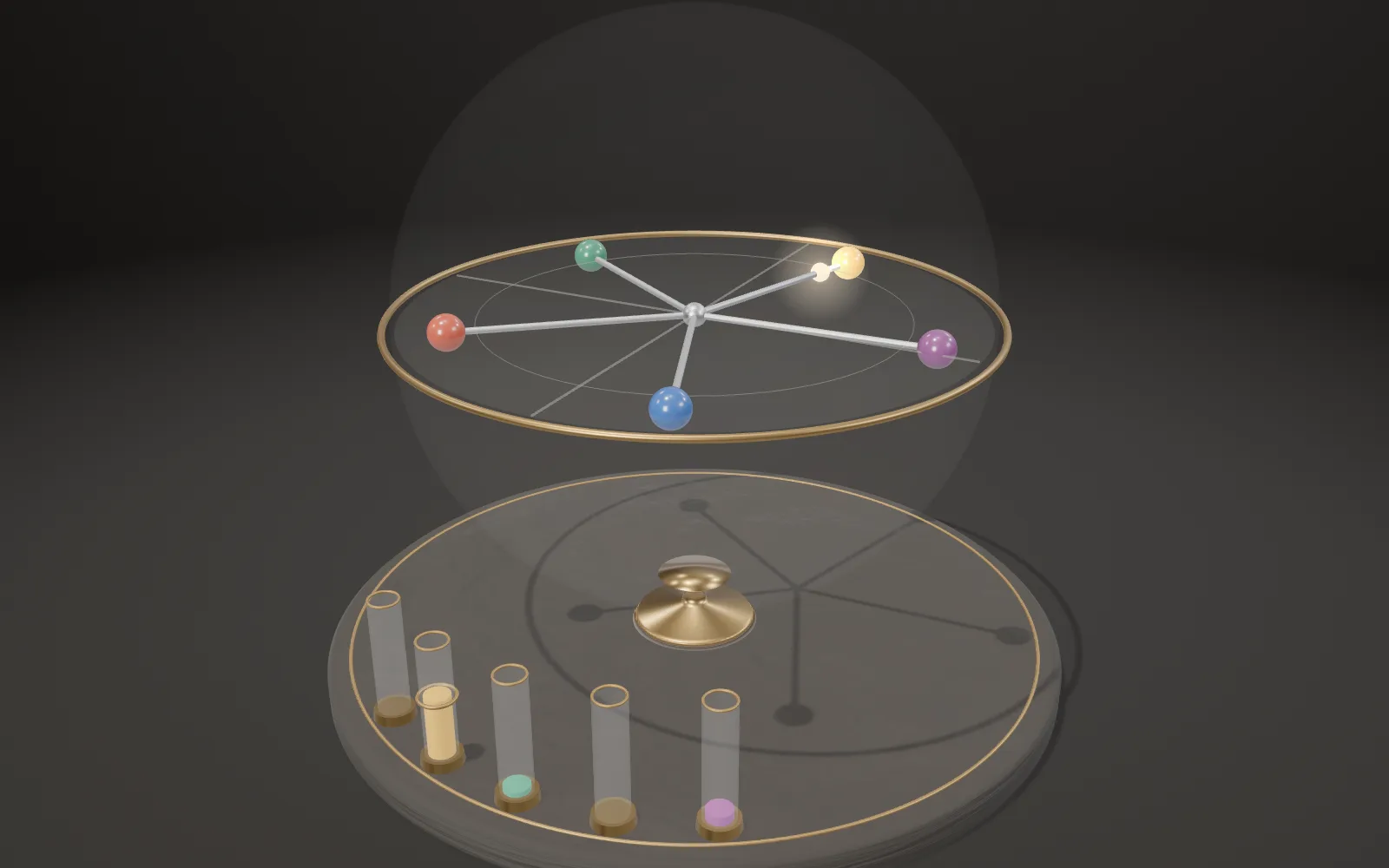 Plate 43More Features Than NeuronsA single neuron in a neural network often stands for several unrelated things. A model with just two neurons can arrange five features into a pentagon and keep them all.
 Plate F22Embeddings: The Geometry of MeaningA black-lacquered, gilt-lined globe set with tiny pictures and brass name tags. Each is a direction from a small model: a picture and its caption point almost the same way.
 Plate F13Attention in TransformersA two-layer, eight-head Transformer reads a sentence in your browser, one character at a time, and guesses the next. Each thread is one act of attention; its brightness is the weight.
 Plate F29Learning from Human FeedbackAfter pretraining, a chat model is tuned again on people’s preferences: people compare two answers, a reward model learns to score them, and the model trains against the score. Here: all three steps in a small model, computed in your browser.